What is NLP? NLP explained simply
Neuro-Linguistic Programming, or NLP, is a motivation and communication model developed in the 1970s. It was created through the analysis of very successful psychotherapists and is now applied in various areas of life, such as therapy, sales, leadership, partnerships, and working with children.
In NLP, conversational, behavioral, hypnotic, and body-oriented approaches are combined. Our thinking, feeling, and behavior (Neuro) are systematically changed (programmed) through language (Linguistics). Over the last 25 years, our training team has conducted nearly 20,000 training days. Our managing director is the president of the largest NLP association in the world in Germany.
Table of Contents
- What does NLP stand for?
- What does NLP bring?
- Where does NLP come from? The origin
- Quotes about NLP
- Is NLP dangerous?
- The effectiveness of NLP
- The NLP presuppositions
- The top 10 NLP techniques
- Learning NLP, but how?
- How do I start as a beginner?
- Ways to learn NLP
- NLP training structure
- NLP certificates
- Areas of application

What does NLP stand for?
- Neuro:
Neuro refers to the nervous system, which we need to take in information from the environment through our senses and then process it. Our perception, thinking, feeling, and behavior depend on our nervous system.
- Linguistics:
Linguistics stands for the language we use to communicate outwardly with other people and simultaneously inwardly with ourselves. Words create our inner reality.
- Programming:
Programming refers to a targeted systematic change. The NLP approach means: I change myself as purposefully as possible and maintain this change so that I can build on it. This way, I don't have to start over every time.
You want to improve your communication to interact more successfully with people? You want to be more creative and especially develop your full potential? Then shape your life and personality more successfully and happily!
What does NLP bring?
- Consciously dealing with one's emotions in everyday life
- Sharpening one's own perception
- Communicating in a new quality
- Having a positive mindset
- Sustainably changing negative behaviors
- Finding goal-oriented solutions
Participants learn useful techniques in their NLP trainings that are supposed to help them in their areas of life.
➤ When something goes wrong again, it doesn't necessarily have to be bad.
The question is: "How do I make the best of it? Why could the situation even be good for me?"
➤ Even behind negative behaviors, positive intentions can be hidden. Acting stubbornly and defensively could, depending on the context, even be helpful.
The question is: "Where could my behavior be useful?" Overall, NLP promotes self-reflection.
NLP graduates often report that NLP has changed their perception and that they had a much more positive mindset after the training. Sometimes a single thought is enough to bring about change.
Of course, NLP can also be used in therapeutic areas. For years, the method has successfully entered psychotherapeutic practices, counseling centers, and psychosocial institutions. Alternative practitioners and psychotherapists use NLP to sustainably change their clients' behaviors.
Professional NLP trainers use NLP Techniques in goal-oriented coaching and thus promote the strengths of the coachees. The application areas of NLP are immense, and there are no limits to the application of NLP.
Free eBook: What is NLP?
We have compiled all the content from this website for you as an eBook. You can download it for free and read it at your leisure.
From the content:
What does NLP stand for – What does NLP bring – Where does NLP come from? – Quotes about NLP – Is NLP dangerous? – The effectiveness of NLP – The NLP presuppositions – The top 10 NLP techniques – Learning NLP, but how? – How do I start as a beginner – Ways to learn NLP – NLP training structure – NLP certificates – Application areas

Where does NLP come from? The origin


Richard Bandler, John Grinder und Frank Pucelik met in the seventies. John Grinder was at that time an assistant professor of linguistics at the University of California in Santa Cruz. Richard Bandler was a mathematician, gestalt therapist, and computer specialist. Together with Frank Pucelik, they wanted to continuously learn and develop.
They discovered how experts achieved extraordinary results in their fields. Thus, John Grinder, Richard Bandler, and Frank Pucelik began to model successful people (modeling) and to recognize the patterns they used to achieve their goals. For example, they investigated why some well-known psychotherapists had so much success treating their clients while others did not. They realized that there must be a common behavioral pattern underlying their work.
Bandler, Grinder, and Pucelik developed a model that is applicable to everyone and promotes communication, learning, and personal change. They called it "Neuro-Linguistic Programming". Bandler, Grinder, and Pucelik shared their knowledge with students in workshops and seminars. They became famous primarily for modeling hypnotherapist Dr. Milton Erickson, family therapist Virginia Satir , and gestalt therapist Fritz Perls.
Learn more about the history of NLP.
Quotes about NLP
"If any person can do something, you can too!"
Richard Bandler
"NLP is the language of change."
Ralf Stumpf
"Whatever another person says cannot make us into what they see us as, as long as we do not allow it ourselves."
Virginia Satir
"The only thing standing between you and your success is the story, that you keep telling yourself!"
Anthony Robbins
Is NLP dangerous?
Warning! NLP is dangerous when the practitioner has not completed professional training that clarifies what problems can arise with certain treatment methods. If done incorrectly, trance inductions, confrontational therapeutic measures, and trauma treatment can cause long-term psychological damage to the client.
Many interventions should not even be carried out if there is no qualification as a healer or psychotherapist. Professional NLP trainers know exactly how far their competencies extend and where their limits lie in application.
On the other hand, NLP can lead to exaggerated self-esteem and feelings of omnipotence. Consequently, practitioners may believe that they are invulnerable due to their knowledge. Completely free from the burden of self-criticism and through self-affirmation, practitioners can lose their grounding.
The criticism of NLP often lies in the bias, ignorance, hasty associations, and negative individual experiences of the respective person. Although the roots of the method are anchored in science and there are many studies that speak for its effectiveness, there are still critics who claim that NLP is not scientifically founded enough.
Others believe that with the help of NLP one can read thoughts and manipulate people . NLP is a danger! A glimpse into the techniques opens up many new possibilities, which can lead to deliberately steering a person's behavior in a preferred direction. The knowledge about oneself and others, and a deep understanding of people, can be referred to as manipulation.
One should also approach the promises of loud marketers with skepticism. "NLP leads to happiness, wealth, and success" is a popular phrase that should not be taken too seriously. It is not that simple in reality.
More information on the topic: NLP and esotericism, NLP is a scam, NLP and Scientology, Abuse of NLP, NLP is useless, Connection between NLP and a cult, The differences between NLP and a cult.

The effectiveness of NLP
The subconscious plays an important role in decisions and actions. Richard Bandler and John Grinder also started from this assumption in the seventies. They take into account in their work that the unconscious must be included in profound change work. Only when the brain is considered can the change work prove to be truly sustainable and effective.
A new behavior must be programmed and practiced. Neural connections that are frequently used form a "brain highway", whereas connections that are rarely used "overgrow" like a jungle. If the behavior is not programmed correctly, it can happen that the brain chooses the old path again and drives on the brain highway.
What does this have to do with NLP? In NLP, new behavior is made accessible to the brain. Through a so-called future pace, action alternatives for the future are programmed into the brain's network. Also, the goal of NLP, to no longer have to deal with a problem but to focus on the solution, opens up readiness for change. Practitioners can use various tools to specifically and sustainably change behaviors and emotions.
The NLP presuppositions
The map is not the territory.
We all have different perceptions of the world, but none of these perceptions
fully and accurately represent the world. People do not react to reality
itself, but to their own representation of reality.
There are no mistakes – only feedback.
Every reaction and every event can
be used as feedback and as an opportunity to learn.
There are no right or wrong models of the world.
However, for certain tasks, some models are more useful than others. If someone wants to go hiking with a road atlas,
they are not using a very useful model. A hiking map would be much simpler for the hike. Nevertheless, the
road atlas is not wrong.
Every person has all the resources within themselves.
In NLP, we assume that people are full of resources. However, sometimes they do not have access to them.
Then, an experienced programmer helps to restore access. With suitable resources, people can solve problems
and achieve amazing things.
People make the best choice available to them subjectively within their model of the world.
When people have other and more appropriate options available for fulfilling their needs, they would
not do much of what sometimes seems to happen out of pure malice.
Behind every problematic behavior/symptom lies a good intention.
Every behavior serves a positive function in the life of the individual, regardless
of possible negative side effects.
For every behavior, there is a context in which it can be meaningful or useful.
Once learned, always learned, meaning that the behavior eventually leads to the desired goal.
The goal is also to develop more choices in addition to this behavior.
Resistance in the client means a lack of flexibility on the part of the consultant.
Resistance does not result from the malice of the other person, but is an indication of
a lack of rapport. The consultant can therefore do something to ensure that the connection with the client is right.
If something doesn't work, do something else.
Too often we expect that we just need to try long enough. But if you run into a wall,
it can take quite a while before you get through it. It would be good to try a different approach and
for example, look for a door.
Here you can find more about the NLP presuppositions.

The top 10 NLP techniques
NLP offers effective methods in various fields of application. They serve to improve communication and the respective areas of life. All techniques are fundamentally effective; you just have to know how to implement them. Apply the techniques in everyday life and improve your perception.
-
1. Rapport

(Canva: © Industrial Photograph) By Rapport we mean the positive relationship between individuals, characterized by mutual respect, understanding, and trust. Masters of communication meet their conversation partner in their experience of the world and lead them on this basis. First, rapport, that is, trust, is established. In Pacing , the person who wants to lead adjusts their behavior, body language, Facial expressions, voice, and language to that of the conversation partner. Then they move into leading.
Exercise: Do you have a conversation coming up that absolutely needs to go well? Maybe a job interview or meeting. Take a partner and practice with them how you could best establish rapport. Here you will receive a few suggestions and ideas .
-
2. Anchoring

(Canva: © Szepy, Getty Images Pro) An anchor is a stimulus (trigger) that elicits a specific, always the same reaction in a person. For example, hearing a song can be associated with feelings of love and memories. Conscious anchoring represents an extension of classical conditioning according to Pavlov and allows for the intentional creation of desired emotional states.
Exercise: Put yourself in a situation where you laughed a lot. Notice the feeling of amusement closely and set an anchor just before the peak, e.g., a clenched fist. Interrupt the situation briefly and then test again – the anchor should evoke the laughter again.
-
3. Six-Step Reframing

(Canva: © Industrial Photograph) Change your behavior in six steps. Consider which behavior you want to change and identify the underlying pattern. Establish contact with the part within you that is responsible for the behavior. With the help of your creative part, you develop new behaviors and ensure that you implement them in the future. Take a close look at the Six-Step Reframing
-
4. Swish Technique

(Canva: © Szepy, Getty Images Pro) With the Swish Technique unpleasant habits can be dissolved and strong motivation can be built. Imagine a picture of your unwanted behavior and additionally create a target image. Now do a swish with both images: The triggering image of the context you enlarge and brighten. Then you place a small dark image of the target vision in the lower right corner. The small image gets bigger until it completely covers the first image. And swish!
-
5. Representational Systems: VAKOG

(Canva: © Industrial Photograph) Humans experience the world through their senses. In NLP, five different senses are distinguished: visual (seeing), auditory (hearing), kinesthetic (feeling), olfactory (smelling), and gustatory (tasting). By sharpening your senses, you can significantly improve your perception.
Exercise:Three people have read the same book and report on their experiences. Who uses which Representational Systems ? Here is the task .
-
6. Meta-Model

(Canva: © Szepy, Getty Images Pro) When speaking, people often leave out information, generalize or distort it. Often, deletions, generalizations, and distortions are used. If a sent message does not correspond to the intended message, misunderstandings can occur. The meta-model is helpful, to delve into the deep structure of a behavior or problem.
Exercise:Pay attention in the next conversation to what language your counterpart uses. If something is unclear, ask for clarification. When can you apply the Meta-Model and certain questioning techniques to clarify misunderstandings in conversation?
-
7. SMART Method

(Canva: © Industrial Photograph) Set your goals with the SMART method. These should be well-formed, specific, measurable, attractive, realistic, and time-bound. Do you have a goal in mind right now?
Exercise: Find a place where you feel particularly comfortable. Take pen and paper and think: What goals and dreams do you have, that you have always wanted to implement? Write down your well-formed goal and apply the SMART criteria.
-
8. Time-Line

(Canva: © Szepy, Getty Images Pro) With the help of a timeline (the “Time-Line”) goals can be systematically planned. You take into account the past, present, and future and develop an irresistible vision. There are different types, e.g., the In-Time and the Through-Time type.
Exercise: Use the technique of Enticing Future to plan your future. The Re-Imprinting according to Dilts also helps in processing old traumas.
-
9. Milton Model

(Canva: © Industrial Photograph) The Milton Model is the linguistic inversion of the Meta Model. With unspecific language, deletions, generalizations, and distortions, a trance state is induced to activate unconscious resources.
Exercise: Find a conversation partner and put them into trance and relaxation using the language patterns of the Milton Model. Use formulations like "Maybe you notice right now..." or "While you listen to this..." to create a gentle guidance.
-
10. Strategies

(Canva: © Szepy, Getty Images Pro) There are macro and micro strategies: Macro strategies describe the rough career development (high school → university → doctorate...), micro strategies analyze your internal processes. With strategy models, you can specifically recognize and replicate success and learning patterns.
Exercise: Try the Love Strategy : Recall a moment of great love, identify the individual steps, and deliberately evoke the feeling.


Learning NLP, but how?
As the saying goes: Practice makes perfect. No master has fallen from the sky. Imagine you come home from a tiring NLP training weekend and put your documents in the desk drawer. Three weeks pass, and you find your documents by chance. You realize that you can only remember a few exercises. What do you do now?
Decide to:
- Repeat some exercises and apply them in everyday life
- Participate in one of our NLP practice group evenings
- Form your own practice groups and regularly exchange ideas about NLP there
- Attend further seminars, trainings, and NLP online courses from Landsiedel NLP Training
How do I start as an NLP beginner?
From a variety of training offers, you can put together your desired NLP beginner program. Maybe you want to focus on NLP and become a master in this field. Perhaps you want to work as a coach and give seminars. Depending on the level, you can get an NLP training starting from 598 euros up to 3,000 euros. The earlier you book, the cheaper the price. A Life Coach training is available from us starting at 298 euros.
Which offers are relevant? Ask yourself the following questions:
- Which topics interest you the most?
- Do you want to learn NLP from home or in a group on-site?
- How can you implement the content of the training in your everyday life?
- What do you want to do with your completed training later?

Ways to learn NLP
World of NLP - study from home
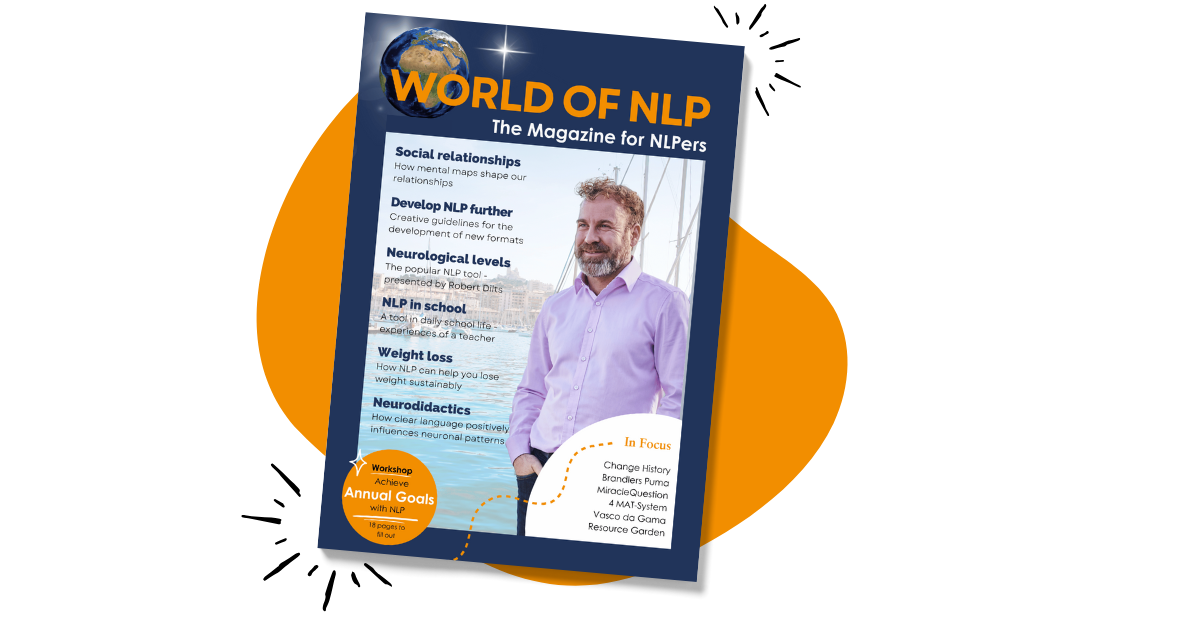
You currently have no time to attend seminars and trainings, but would still like to continue your education? Do you prefer to learn from home or are you often on the go for work? No problem. Now you can also complete your NLP degrees through distance learning. Check out our >> World of NLP. There you can start for free, and if you want more, you can also obtain your degrees as Practitioner and Master there. The World of NLP now contains over 800 courses and thousands of lessons. More than 13,000 members are already part of Germany's largest NLP community. It is suitable for participants who have already completed an NLP training as well as for participants who are engaging with the subject for the first time. Audio and video courses combined with learning lessons will gradually make you an expert. Upon successful completion of the ongoing testing, you will receive the NLP Online Practitioner and NLP Online Master certificate in the study variant.
More about World of NLP.
Seminars and trainings
NLP enthusiasts have access to a range of NLP seminars and training programs offered by Landsiedel NLP Training. There are online and in-person seminars. Upon successful completion of the training, we award the international certificate of the world's largest NLP association. Overall, the difference between a seminar and a training at Landsiedel NLP Training lies in the duration, group size, and corresponding certification.
Develop your personality in the NLP training to become an NLP Practitioner, NLP Master, NLP Trainer, or NLP Coach. In the training, you will learn NLP at the highest level in a group of like-minded individuals at low prices.
Follow us on YouTube

On our YouTube page you will find numerous videos on the topic of NLP. Also, check out the recordings of an NLP introductory workshop at the NLP Congress in Nuremberg with Stephan Landsiedel. Learn more about the fascinating world of NLP.

Free NLP package for beginners
*Already more than 30,000 readers (2 e-books, 90 pages + audiobook mp3)
You will learn the following from this book:
- Optimize your communication
- Bring more energy into your life
- Experience intense emotional states
- Become a personality
- Dream big with the Walt Disney strategy

NLP Practitioner
As the first level of training, The NLP Practitioner training provides fundamental theoretical knowledge and practical skills regarding the techniques and methods.
NLP Coach
The training as an NLP Coach, according to the standards of the ICI (International Association of Coaching Institutes), imparts the necessary skills and knowledge to be successful as a coach. The coaching training focuses on applying the learned methods of NLP Practitioner in concrete coaching contexts.
NLP Master
After the NLP Practitioner training, the NLP Master training is completed. The learned formats are practiced in different situations and contexts. Additionally, some new elements are introduced.
NLP Trainer
All necessary skills and knowledge required to conduct NLP trainings are conveyed in the NLP Trainer Training. Furthermore, the training is interesting for participants who would like to professionally design their seminars, lectures, and workshops with the help of NLP. NLP should be applied at the highest level, and its pedagogical and communicative skills should be expanded.
NLP certificates
We are authorized to certify according to the following associations:
- NLP-IN - International Association of NLP Institutes
- INLPTA – International NLP Trainer Association
- DVNLP – German Association for NLP
- LNLPT – Landsiedel NLP Training


The associations
NLP Institutes: The International Association of NLP Institutes is the world's largest NLP association with over 10,000 members. Each country has its own president who supervises the master trainers and ensures the development and adherence to high standards regarding quality, professionalism, and ethics. The association organizes world congresses and has its own projects that advance NLP globally. The certificate from this association is included as standard with us.
DVNLP: The German Association for Neuro-Linguistic Programming e.V. is a large expert forum for people who use NLP in professional and private contexts. The association establishes curricula and monitors compliance with the rules by the teaching trainers. Once a year, a congress and an event called Future Tools take place.
INLPTA: The International NLP Trainers Association is an international, globally operating NLP trainer association that focuses on quality, professionalism, ethics, and business applications in NLP. It is represented and connected with its own coordinators in China, Japan, the USA, Australia, New Zealand, and most European countries.
Areas of application
NLP is used wherever communication and the realization of one's own potential are important:
- in the field of psychotherapy
- in business (e.g., in management, in human resources, in sales, in consulting, in training, in personnel development, and in corporate functions),
- in healthcare
- in the personal development
- in sports
- in promoting one's own mental and physical health
- in politics
- in education
- in the legal field
- in developing creativity in writing, in the performing and visual arts
- in hobbies, etc.
These individuals have solved their everyday problems with NLP techniques: NLP examples - witnesses report their successes
NLP in companies
Every communication begins with ourselves. Good rapport, precise goals, and excellent behavior are three of the most important aspects of "Inner Management." Naturally, optimizing one's own behavior also enhances the quality of leadership in both professional and personal relationships. In the business world, successful communication, a trusting relationship, and goal orientation are the A and O for a successful workday. To achieve this, it helps to accept and understand colleagues, superiors, and clients within their own worldview. Cultural barriers in multinational companies can also be improved with the help of NLP.
NLP in business means:
- thinking in a solution- and goal-oriented manner
- optimizing perception skills
- learning and developing effective action strategies
Presentation skills and rhetorical training are today a fundamental component of every modern corporate culture. Many leaders and consultants in companies have been inspired by the creative and innovative aspects of NLP. They apply the NLP knowledge base in corporate development, team building, designing future strategies, and as part of a comprehensive quality management system. NLP skills are also increasingly used in negotiation training.
NLP and health
In recent years, NLP research has focused on
- how personal health is achieved and maintained
- how stress can be reduced
- how the body's healing powers can be activated, and
- how the relationship between health and deep-seated assumptions, beliefs, and attitudes can be understood.
Relevant health topics addressed with NLP include: weight loss, anxiety, sleep disorders, depression panic attacks, addiction, tinnitus,, heartbreak, anxiety disorders, smoking cessation. The important question is how recurring patterns and illnesses can be changed so that illness does not reoccur.
For those who want to work alternatively, yoga offers an excellent, usable, and very physical complement to NLP. The physical and mental techniques of yoga can positively influence your life. You develop calm and stillness in a hectic everyday life and improve your health. Learn more about yoga and meditation

What does NLP have to do with psychology?
As psychology in the 19th and 20th centuries focused almost exclusively on depression and mental illness, American psychologist Martin Seligman began to turn the focus around and consciously use positive feelings to bring about change. He found that optimism can be learned and that he wanted to promote the strengths of others.
Positive psychology discovered that one can increase their well-being and sense of happiness by utilizing their character strengths. When a person engages in an activity that makes sense to them and applies their strengths, they live a much healthier life. Happy people live longer and are less susceptible to mental illnesses.
Martin Seligman identified six virtues, to which 24 character strengths are assigned:
- Wisdom and knowledge: creativity, curiosity, open-mindedness, love of learning, perspective
- Courage: bravery, perseverance, integrity, vitality
- Humanity: love, kindness, social intelligence
- Justice: social responsibility, fairness, leadership strength
- Temperance: forgiveness and compassion, humility, modesty, prudence, self-regulation
- Transcendence: appreciation of beauty and excellence, gratitude, hope, humor, spirituality.
NLP in psychotherapy and counseling
Historically, NLP has its origins in various short-term therapeutic, solution-oriented, hypno-systemic, and constructivist psychotherapy approaches. In recent years, NLP psychotherapy has been developed – an independent psychotherapy approach that, however, struggles for professional recognition. In some practices, psychotherapists offer solution-oriented short-term therapies and use NLP purposefully. Apart from that, there are overlaps in the treatment methods of classical psychotherapy and neurolinguistic programming. The treatment of phobias with NLP is probably the most well-known. It can help people overcome a phobia in a very short time.
NLP offers tools...
- to establish trusting relationships with different clients,
- to understand the holistic structure and effect of attitudes, beliefs, values, and self-images,
- to process-oriented work that protects both the integrity and privacy of clients while facilitating lasting changes,
- to an expanded understanding of the effect of language,
- to a solution-oriented and short-term therapeutic setting.
NLP, education, and school
The earlier children learn to communicate, the better. Of course, it also depends on the social environment they are in and what they observe from others. NLP fundamentally promotes communication between parents and children. Adults discover how to communicate with their children in a positive, understanding way.
By expressing themselves clearly, parents enable their child to understand them and respond appropriately. In communication, word choice is particularly important. Constant negations can negatively affect the child's behavior. "Don't spill" may lead to even more spilling, as the child must first think about the action to follow this command.
Those who want to understand children should put themselves in the child's world. Only then can it be ensured that the message actually arrives and is understood.
- What does my child already know?
- How does it feel right now?
- Does it understand me?
NLP can also be helpful in the school system. Certain learning strategies are useful to assert oneself and withstand performance pressure. Tools for effective learning should contribute to the development of the self-confidence. Learning should be fun and is even healthy!
Free E-Book: More Joy of Life with NLP
In the E-Book, I present some very important NLP foundational techniques. It is about state management, anchoring, and goals, for example.
The E-Book is primarily written for NLP beginners or those revisiting NLP who want to refresh their basic knowledge in a motivating way. Dive into the adventure of your life! You are a unique being, and you deserve to celebrate great successes in this life and attract everything you wish for.

Read more here: