John Grinder -- Co-founder of Neuro-Linguistic Programming (NLP)
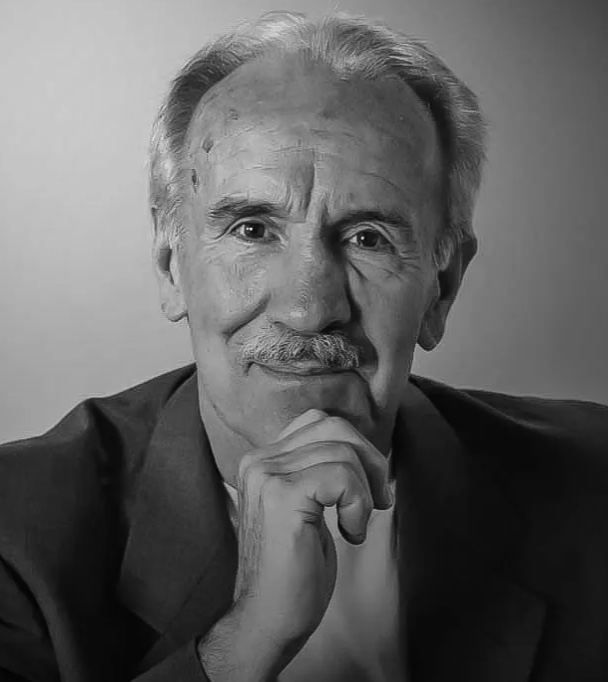
John Thomas Grinder is, alongside Richard Bandler, one of the two co-founders of Neuro-Linguistic Programming (NLP). As a linguist, he brought a unique scientific perspective to the emergence and development of NLP. His research on transformational grammar, his work with Richard Bandler, and his deep understanding of language and communication played a crucial role in the field of communication psychology in the 20th century.
Early Years and Education
Little is publicly documented about John Grinder's childhood. He was born on January 10, 1939, in Michigan, USA. He studied philosophy at the University of San Francisco, after which he entered the military and served in Europe. After working for several years as an undercover agent for the CIA, he began his linguistics studies at the University of California in San Diego in the late 1960s, which he completed with a doctorate. He specialized in the topic of transformational grammar according to Noam Chomsky. Early on, he showed an interest in structural language, particularly syntax and the construction of linguistic meaning.
Academic Background
After earning his doctorate in linguistics, Grinder worked as an assistant professor at the University of California in Santa Cruz at Kresge College during the 1960s and 70s under Gregory Bateson, who in some ways served as a mentor to Grinder. There, Grinder published scientific papers on the grammatical structure of Spanish dialects and taught theoretical linguistics with a focus on generative grammar.
Encounter with Richard Bandler & Collaboration - The Joint Development of Neuro-Linguistic Programming
In the early 1970s, Grinder met then psychology student Richard Bandler, who offered practical seminars on Gestalt therapy at UC Santa Cruz. Bandler asked Grinder to observe his work as a supervisor/assistant professor of linguistics. Impressed by Bandler's intuitive understanding of linguistic mechanisms, Grinder began to systematically explore his linguistic behavior. Their elaborate activities and insights are described in detail by Grinder together with Richard Bandler in the work 'The Wild Days. NLP 1972-1981'.
John Grinder and Richard Bandler combined their strengths: Bandler brought in the intuitive modeling of successful therapists, while Grinder conducted an analysis of linguistic patterns through his linguistic knowledge. Together, they developed the Meta-Model of language, which identifies typical linguistic distortions, generalizations, and deletions. This model became the foundation of their first joint book The Structure of Magic I (1975). Later, they also examined nonverbal communication.
The Meta-Model was the starting point for further NLP techniques. Grinder and Bandler began to model outstanding communicators and therapists such as Milton Erickson, Virginia Satir, and Fritz Perls. From this work emerged a variety of new interventions and strategies, such as the Milton Model (patterns of hypnotic techniques), anchoring techniques, reframing, and submodalities work.
Grinder always insisted on the precise description and transferability of the observed patterns, which gave NLP its methodological depth. It was important to him that Neuro-Linguistic Programming be understood as a modeling discipline and not as a rigid set of methods. Thus began the history of NLP.
NLP is now widely used in coaching and therapy.
Spread and Teaching Activities in the 1970s
After the development of the Meta-Model and the publication of The Structure of Magic, Grinder and Bandler began to teach NLP in seminars and workshops in the USA and later internationally. The demand for their content grew rapidly, especially after the publication of Patterns of the Hypnotic Techniques of Milton H. Erickson (1975/77), which documented their work with Erickson's language patterns.
During this time, Grinder was an active trainer and teacher. Together with Bandler, he led many of the early NLP trainings -- including the well-known training 'Frogs into Princes', which was published as a book in 1979 and made NLP known worldwide.
These years were characterized by intensive teaching activities, seminars for therapists, educators, business consultants, and medical professionals. Grinder placed particular emphasis on the scientific foundation and structure of the model.
Many of today's well-known NLP trainers (e.g., Robert Dilts, Judith DeLozier, Steve Andreas, Leslie Cameron) learned directly from Grinder and Bandler during this phase.
New Projects and New Code NLP
In the 1980s, Grinder increasingly distanced himself from the commercialization of classical NLP. Together with Judith DeLozier and later with Carmen Bostic St. Clair, he developed the New Code of NLP. This places a stronger focus on unconscious processes, wholeness, state work, and ecology in the sense of sustainable change.
The New Code emphasizes that the coach or practitioner must also be in an optimal state to work effectively. Grinder developed formats such as the 'Alphabet Game' and 'High Performance State Training' for this purpose.
John Grinder's Training Style and Philosophy
John Grinder's style is distinctly different from Richard Bandler's. He is more factual, structured, and analytical. His trainings are highly experiential; he uses many practical exercises, body language, feedback loops, and places great importance on learning by doing. Grinder challenges his participants to take responsibility for their thinking and actions.
His philosophy is clear: NLP is not a belief, but a toolbox. It is not about truths, but about what works. This pragmatic attitude runs through all his work.
Quotes and Anecdotes from John Grinder
John Grinder is known for his concise style, sharp formulations, and pragmatic attitude. Here are some notable quotes:
“NLP is an attitude supported by a methodology that leaves a technique behind.”
“If you can't model it, you don't understand it.”
“There are no resistant clients, only inflexible communicators.”
Anecdotes:
In a training, Grinder provoked a participant who claimed he was 'not creative enough' with increasingly complex tasks. The learning effect occurred when the participant stopped analyzing and simply acted. Grinder commented: “The body knows it already -- the mind just lags behind.”
In Whispering in the Wind, he mocks NLP practitioners who avoid the Meta-Model: “They develop a phobia of the Meta-Model because it is too exhausting. Then they prefer to model their own avoidance -- at least that is consistent.”
Influence and Legacy
John Grinder's influence on the field of personal development and communication is profound. He has not only significantly shaped the foundations of NLP but has also shown new ways with the New Code NLP for deeper, more sustainable, and ecological change.
His insistent stance on precise modeling and his criticism of commercialization have helped many practitioners view NLP more differentiated. Many trainers and schools worldwide, including internationally recognized institutes, continue his methods or orient themselves towards the New Code NLP.
Grinder's work has also intellectually elevated NLP -- through his connection to linguistics and his claim to systematically and transferably model human behavior. His books are still considered foundational works today.
Current
John Grinder is still active internationally. Together with his wife Carmen Bostic St. Clair, he runs the 'International Trainers Academy of NLP', which is dedicated to quality assurance in NLP training.
He offers training and certifications worldwide -- especially on the New Code NLP -- and works closely with a network of qualified trainers. It is important to him to train new generations of NLP practitioners who apply NLP with integrity, precision, and ethical awareness.
He also occasionally gives lectures at international conferences, writes professional articles, and stays connected with the NLP community through digital channels. Despite his age, he remains a prominent voice in the discourse on NLP, change work, and personal excellence.
Important Works by John Grinder
Grinder is the author and co-author of numerous influential books. A selection:
- The Structure of Magic I (with Richard Bandler), Part II: A Book About Communication and Change -- Foundations of NLP German: Meta-language and Psychotherapy. The Structure of Magic Volume I & Communication and Change: Volume II
- Frogs into Princes (with Richard Bandler) -- popular introduction to NLP
- Reframing. An Ecological Approach in Psychotherapy (NLP) - Introduction to Reframing (with Richard Bandler)
- Patterns of the Hypnotic Techniques of Milton H. Erickson (with Richard Bandler)
- Turtles All the Way Down (with Judith DeLozier) - Working with Beliefs
- Whispering in the Wind (with Carmen Bostic St. Clair) -- a comprehensive reflection on NLP and its origins
- Therapy in Trance (Concepts of Human Science) -- Neuro-Linguistic Programming (NLP) and the Structure of Hypnotic Communication - includes practical techniques and exercises for hypnosis with case studies from therapeutic contexts
We conducted a detailed Interview with John Grinder here: https://www.landsiedel-seminare.de/nlp/wichtige-personen/john-grinder-interview.html
Sources
- Grinder, John / Bandler, Richard: The Structure of Magic I & II
- Grinder, John / DeLozier, Judith: Turtles All the Way Down
- Grinder, John / Bostic St. Clair, Carmen: Whispering in the Wind
- Official Site: www.johngrinder.com
- NLP University: www.nlpu.com