NLP and manipulation
A frequently raised accusation revolves around NLP and manipulation. This allegation is based on the idea that one aspect of NLP consists of using various formats (Rapport creating, Pacing/Matching/Leading, communicating in the same representational system, etc.) to influence a conversation in one's own sense. This gives rise to the assumption that NLP and manipulation are inextricably linked, leading to the fact that the two terms are sometimes used synonymously.
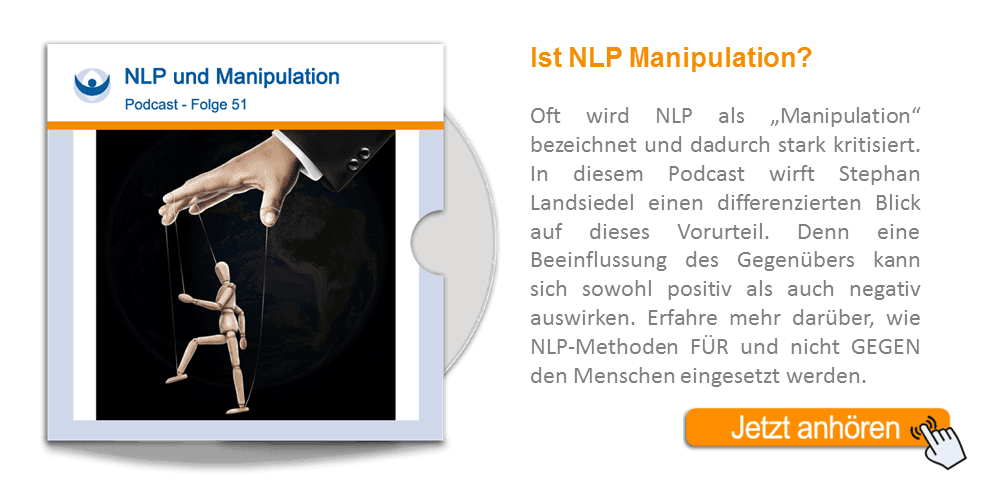
Critics take the claim of some NLP practitioners that influence through NLP and manipulation with NLP are practically self-runners and have absolute
success guarantees more than just literally: They attribute to Neurolinguistic Programming a certain effect that can actually only be achieved by specific invasive techniques like hypnosis. This creates the image of NLP and manipulation as a toolbox for
professional deceivers, who can reduce their gullible and helpless environment to mindless automatons at will with Jedi tricks. A
notion that may have its appeal in some respects, but – as any NLP practitioner can surely confirm – is quite far from the
reality: NLP and manipulation do not make the impossible possible.
There is indeed a connection between NLP and manipulation, but differently than critics generally assume. First of all, one must
acknowledge that, on the one hand, not every manipulation is automatically NLP, and manipulation, on the other hand, is basically any undisclosed form
of influence: And even if the latter is just the circumstance of appearing friendly towards strangers or trying to convince someone of something. Entire professions manipulate in one way or another: Politicians, lawyers, psychologists, salespeople, and many others. They
generally do not consciously use NLP, yet manipulation is still part of their daily work. Furthermore, it is normal in dealing with other people
to establish a viable rapport with a person, thus conveying a good feeling in their interaction. That is exactly what one does when using the corresponding NLP formats.
Another aspect that is fundamentally neglected in this regard is the share that the influenced party has in the success. The willingness
of the counterpart to engage in this kind of "manipulation attempts" is essential for success: One cannot "force" someone to find a person likable or to follow certain arguments. The decision in such matters ultimately lies with the
individual themselves, and not with the one who links NLP and manipulation.
Seminar paper "Manipulation through Neuro-Linguistic Programming?"
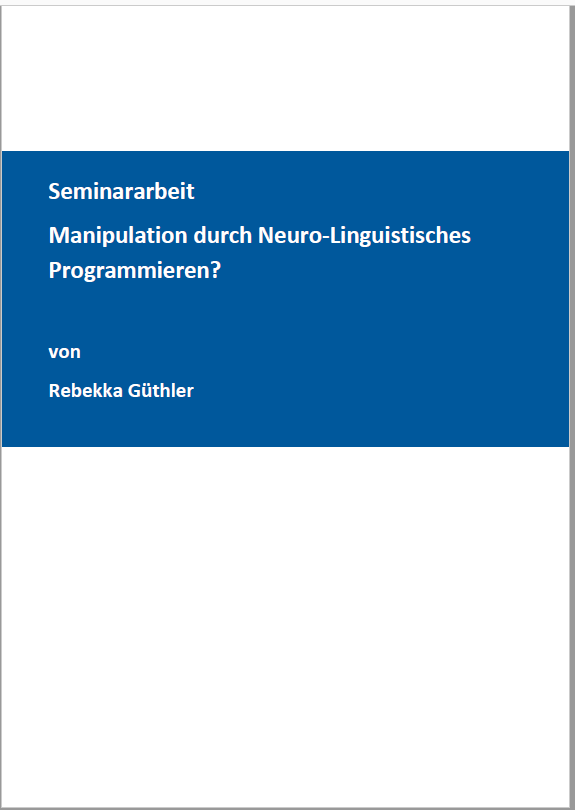
In the German Duden, manipulation is defined as "an opaque, skillful approach by which someone gains an advantage or acquires something desirable". The term can also be presented as "consciously influencing the other". - Rebekka Güthler
Is NLP manipulation?
In this e-book, Rebekka Güthler examined to what extent NLP is consciously used to gain benefits even against the conversation partners.
To illuminate this, various practice-relevant application examples are presented based on a compressed introduction to NLP. Additionally, different opinions from NLP practitioners regarding the manipulative power of NLP are analyzed. Various scenarios are outlined that show how and in which areas NLP could have a manipulative effect. My goal is to objectively consider the controversial, ever-present discussion. Finally, various response options to the question are presented, and a conclusion is drawn from the collected information.
Accusations of the abuse of NLP often arise. What is on the other side of the coin and how do we deal with it. Abuse of NLP