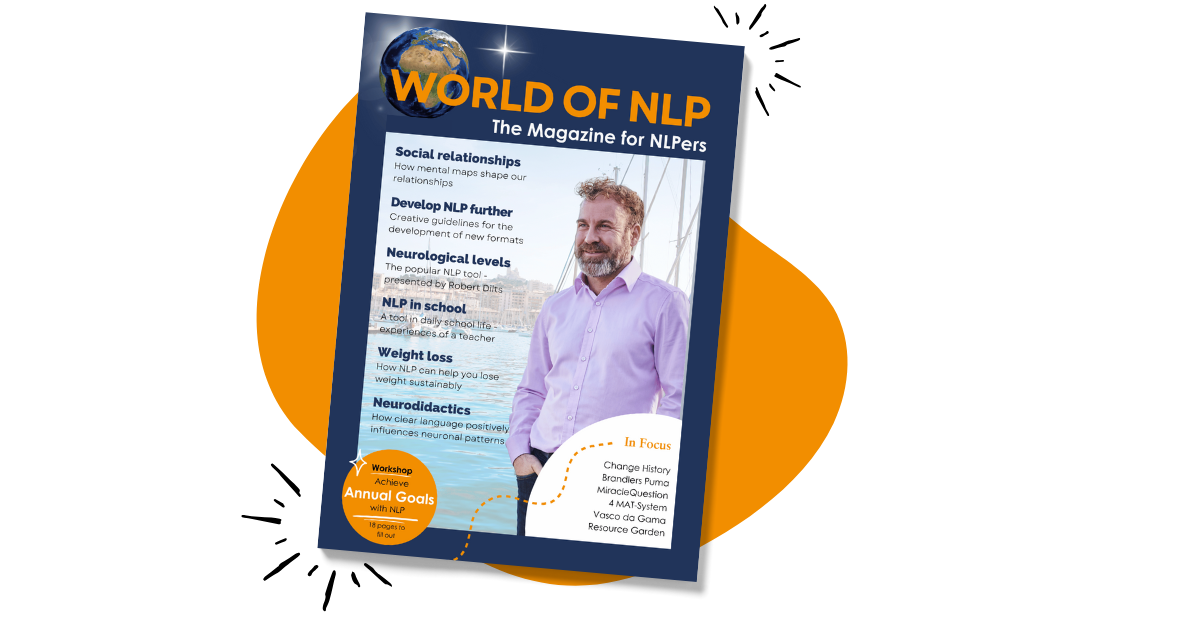
The future of NLP is yellow
Prologue
The NLP of the future will be tailored to the individual user and will take context variables into account much more strongly than the previous standard interventions in psychology. Standard formats will be used to learn from and discover the fundamentals. After that, users will learn NLP to tailor it to themselves and their lives. This will make NLP even more attractive to growth- and development-oriented individuals. The application of NLP in various fields such as schools, kindergartens, healthcare, and professional life will be further developed. The skepticism of science and politics must be overcome. Through a more consistent use of modeling strategies, many more concrete application fields will be opened up. NLP will become a companion to an integral lifestyle. Individually tailored mini-interventions will help each of us live more of our potential: personal development, maintenance and optimization of one's own health, improvement of communication, achievement of goals, and much more. When a critical threshold is crossed and more trainers, coaches, and users publicly commit to NLP, we will witness how it spreads rapidly, reaches large crowds, and ultimately finds a dissemination that we can only dream of today. Then "NLP for all!" will be possible.
Summary
This article describes where I see the future of NLP. In doing so, I also want to reposition NLP. Until now, NLP has been a toolbox full of methods for optimizing communication and an effective coaching and therapy tool.
For me, NLP is primarily a method for the personal development of each individual. It contributes to more and more people being enlightened in their own way and realizing their best potential in the sense of the integral model, thus making their contribution to the well-being of humanity.
It is about integrating NLP into one's own life and thus continuing to develop as a person. My goal is to encourage people to activate their full potential for the benefit of all and the planet.
My background
When I entered the NLP scene in the 1990s, NLP was a highly effective therapeutic tool. In 1995, I attended my NLP Practitioner Training in Landau in the Pfalz. It was led by two clinical psychologists. I was in my early 20s at the time. The next youngest participant was 35 years old and was still studying psychology. Many of the other participants were experienced psychotherapists. Everywhere you heard and read the phrase: "NLP was created when the best therapists of their time modeled their work."
Personally, I initially came from a related but somewhat different direction. I had started at the age of 15 to engage with the theories of Sigmund Freud, Alfred Adler, and then Carl Gustav Jung. Jung fascinated me the most, especially his approach to individuation. Individuation refers to the process of becoming whole, finding and unfolding one's own uniqueness. I eagerly read the books of Hermann Hesse: Siddhartha, Steppenwolf, and many others. It was the path to myself and the search for a very personal meaning of life. I felt that the deepest of all secrets was hidden within us. There was something inside me that wanted to go out into the world. The idea that there was a reason I was born into this world - a task - a quest - a call. Back then, I wrote in my diary: "From today on, I will take my education from my parents and take charge of my own training."
At that time, some thought games began in my head. I gathered the heads of state and religious leaders in one room and let them discuss how to transform this world into paradise. I suspected that this must be a common goal for all present. I quickly realized that it wouldn't work if different religions (including the Christianity of my childhood) claimed that they alone had found the one true way. Suddenly, someone like the Dalai Lama became very sympathetic to me, as he said: "The heart of all religions is one." And I understood him to mean that the commonalities at the center of the teachings are much more important than the differences at the edges, which manifest in different rituals, customs, books, and stories.
After graduating from high school, I was fortunate to be one of the last cohorts to serve 15 months in civil service. I cared for elderly dying people and looked after disabled children. Whenever I had a night shift and nothing was happening, I read psychology books. I was fascinated by how differently we humans deal with the various challenges of life. I saw elderly dying people who complained about everything, who whined and screamed all day long. But then there were also people like Mrs. Bludra, who was nearly 100 years old and visibly enjoyed life every day. When we brought her food, she often told us civil service workers stories from her long, exciting, and fulfilling life. She knew she had lived! She had done everything that needed to be done. She had taken life to the fullest and now simply enjoyed every day that was still gifted to her, full of joy.
I could also discover amazing things with the disabled children. Some of them were happier than the healthy children. They looked forward to each day, taking the moments as they came. How could that be? Why could children who seemingly had everything be unhappier than disabled children who were severely restricted? The answer had to lie somewhere within us - in our thoughts and attitudes.
When I began studying psychology, I threw myself with great enthusiasm into everything I could learn about it. I also read everything I could find in the library about NLP and other approaches. I studied the great wisdom teachers and motivational trainers. I started my day with affirmations and ended with goal visualizations. I lived in 9m2 for five years and spent some of the best years of my life reading, studying, and experimenting.
In my dormitory, there were 123 students, and there was at least one every day who had some issue I could help with. I could easily pick up my "victims" in the hallways and common rooms of the dormitory and then take them to my couch. Most of the time, they were not therapeutic cases but students who were simply facing some challenges in life: heartbreak, exam anxiety, failing, or a presentation that needed to be given.
NLP for the healthy
Then I experienced for the first time Tony Robbins at a seminar. I was electrified. Tony used NLP in its purest form, but his goal was less to do therapy with it, but to empower ordinary people to achieve peak performance, and that ignited my enthusiasm. I could identify with that.
When my first book "Way up live your own dream" was published in 1998, I was just in my NLP trainer training. Some of the participants read the book, and their feedback was overwhelming. They had no idea that NLP could also be applied so positively for healthy people. Until then, NLP had been more of a therapeutic form that could at best be used for self-therapy. From then on, NLP for me was: "Psychology for the healthy."
NLP in self-application
I began to apply NLP to myself more and more frequently. When I then also got to know the work of Robert Dilts on what he called the Neurological Levels , it became clear: NLP is a tool to shape one's own life. A help in becoming the person I and everyone else would like to be. In Dilts' model, in addition to the well-known levels of behavior and skills (strategies), it is primarily about the higher levels of beliefs/values, identity, and spirituality/vision/belonging. The work on these levels excited me immensely. I began to imagine who I wanted to be and designed a picture of the personality I dreamed of.
I developed a morning program for myself, in which I compiled exercises that trained my mind, connected me with my visions, and allowed me to regularly work on myself and my shadow sides. This included both meditation as well as movement and further education. For years, as a student, I got up every morning at 5:45 AM, at a time when most students were still sleeping. It became clear to me how much we can intentionally change and develop when we are willing to undergo the necessary training for it. I only realized much later that many people learn about NLP in a seminar but do not really apply it in their lives.
What I mean is that they learn a technique in a seminar, perhaps practice it once or twice in a peer group or with someone from their circle of friends, but very rarely and almost never with themselves. NLP works and shows excellent effects when applied regularly. Many use it more as a crisis intervention tool. Well, of course, that can be done. But my concern is to spread NLP as something that helps people make the best of themselves - to lead a life according to their own ideas. This does not mean the same thing for everyone. On the contrary: there are great differences!
The Graves model in connection with NLP
In 1998, I first learned about the Graves Levels of the American college professor Clare Graves. But I passed by it carelessly. Apparently, I did not recognize at that time the potential behind this model. Only a few years later, when I got to know the model again in a different context, it captivated me and has since become my favorite model with the extensions of Ken Wilber and Don Beck. This model describes the development of humans and their values. Depending on where we are in our development, we have different values. It thus provides a series of explanations for why people think and act differently, why they pursue different goals, and why they consider something to be good or evil.
At the same time, it is a developmental model and describes as such in what order a natural development takes place, which needs arise first and which come afterward. NLP can help us as a model that is about change to positively influence development on almost all levels. While the Graves model describes levels of development and we now know where we stand and which thinking currently dominates us, NLP describes HOW this WHAT can be changed. The two approaches thus complement each other excellently.
The development in recent years, which can be traced through the Graves Levels, has also occurred in parallel in the NLP world. With the increasing development of society, NLP has crystallized more and more as a tool for the higher Graves Levels. Initially, many NLP followers were primarily interested in using NLP as a success method to make themselves more capable and successful (orange), but more and more people came to the green development level through NLP, where it is about humanistic values. Many people benefited from experiencing appreciation for their own individual life views. Then more and more systemic thoughts emerged in the world. Systemic constellations sprang up like mushrooms, and the realization that it would be important to consider the respective system in changes became more widespread. This marked the beginning of yellow thinking emerging on the horizon.
I suspect that we have experienced such a stormy development in the last two decades because the people who regularly continue their education and attend seminars are likely also the ones who can most easily access the higher levels of development - at least regarding the cognitive understanding of this level. Trainers and coaches usually attend many seminars, read relatively many books and magazines to inform themselves about newer developments. They may also be the most willing to try new paths.
Brief introduction to the Graves model
A solid introduction to the Graves model far exceeds the scope of these explanations. Interested parties are referred to my other publications on this topic. Here, I would like to briefly describe the model.
The Graves model is often depicted as a spiral to make it clear that development unfolds gradually and is open-ended at the top. Both the individual and humanity gradually go through these phases. Of course, some people may eventually remain at one level and no longer develop further. Some may also fall back to a previous level. Each developmental stage corresponds with environmental factors. Certain prerequisites are needed, such as peace, law and order, stability, etc., for a certain developmental stage to be reached and lived.
At the first level (AN, Beige), it is also about existential basic needs, similar to Abraham Maslow's hierarchy of needs. It concerns food, water, warmth, and sexuality. Humans are driven by instincts and genetic factors. Their goal is survival.
At the second level (BO, Purple), it becomes possible to gain more security through the unification into larger groups in the form of tribes. The tribes provide protection against other tribes or further dangers. Rituals and the first forms of cause-and-effect thinking emerge. People suspect nature gods everywhere and strive to live in harmony with them. The individual must subordinate themselves to the principles of the tribe. The elders' council or the shaman, who proclaims the will of the gods, has the say.
At the third level (CP, Red), a strong ego consciousness awakens. It is about power and the fulfillment of one's own needs, even at the expense of others. If necessary, aggression is employed. Entire peoples are engulfed in war and absorbed into their own civilization. On an individual level, people do everything to satisfy their own needs. They are powerful, impulsive, and heroic.
The third level develops into the fourth level (DQ, Blue). In this level, it is about laws and principles. The red tyranny is curtailed by a clear societal order. The first mono-religions emerge, aiming to provide people with morals and laws for a good life. Those at this level learn to postpone impulsivity and to do something that will bear fruit later. Many dedicate themselves to a higher cause and do what needs to be done in their place. The blue order creates education, police, military, logistics, and quality management in our time.
At the fifth level (ER, Orange), the focus is on moving forward. Natural sciences enable people to make astonishing progress in technology. The principles of economics allow for an enormous upswing. It is about acting strategically and enabling progress. On an individual level, Orange manifests in our performance-oriented thinking, but also in a materialistic attitude. People try to distinguish themselves from others through brands and possessions.
At the sixth level (FS, Green), humans reflect on the fundamental values of friends, people, dialogue, and relationships. The humanistic idea emerges that all people are equal and valuable in their individual uniqueness. There are different opinions, but all should be heard and included in the problem-solving process.
After these six levels, a kind of quantum leap occurs. Up to this point, each developmental level believes that its views are the only correct ones. Only from the next level onward is it possible to integrate the strengths of the individual levels and draw on them as needed. The next level (GT, Yellow) becomes necessary because we cannot solve the current problems of the planet with the earlier levels alone. We need many people who adopt the thinking, skills, and abilities of the yellow level to address the challenges.
Description of the yellow level
At the yellow level, we recognize that there are many different perspectives on reality, all of which can contribute. Each perspective reveals a certain aspect and allows other aspects to fade into the background. In integral theory, we also say that each perspective is true, but only partially.
This is beautifully illustrated by one of my favorite stories. Four blind men are to describe an elephant. The first blind man touches the elephant's leg and says, "The elephant is round and stands firmly on the ground." The second blind man touches the elephant's belly, the third its tusk, and the fourth its trunk. They all have a different perspective and believe theirs to be true. They are all partially correct, but not entirely.
The story is often told in the context of NLP to illustrate that each of us has our individual model of reality, which differs from the models of others. The basis for our model is our experiences based on our senses. Our perception is subject to numerous filtering mechanisms that allow only certain content to enter our conscious awareness.
The map is not the territory
As early as 1938, Alfred Korzybski formulated the phrase: "The map is not the territory" in neurolinguistic training, which generations of NLP practitioners have learned in their training. Each of us has created our own model of the world and thinks and acts within the framework of this model. NLP helps us gain the flexibility to realize "thinking outside the box" by recognizing and overcoming the boundaries of our own model. When we internalize this thought, we can recognize many truths as partial truths that are valid for certain areas but not universally. With a very broad perspective, we can create models that allow us to categorize other models. Just as Ken Wilber has done with his 4-quadrant model and the AQAL theory. Such a model ends the discussions about which model is better or worse because it explains within which validity range which approach should be preferred. A grand learning step in the evolution of humanity.
In Clare Graves' developmental model, the yellow level introduces the second rank (English 2nd tier). It is the first level at which people can appreciate and value the various preceding levels. From the yellow developmental stage onward, there is a comprehensive understanding of the concerns, but also the special abilities of the preceding levels. It is now a matter of balancing these levels; utilizing the strengths and ensuring that the unhealthy side of a developmental level (e.g., National Socialism, Crusades) does not come to the fore too strongly.
At the yellow level, we also recognize that not all perspectives are equally valuable in every context. Some are truer and deeper than others. The "green flatland" is abolished, which most people at the green developmental stage do not like at all. After all, everyone is equal in green! Who could presume (even if limited to a specific context or application area) to claim that their perspective is more important or better than another's? This has led to the famous saying: "When green sees yellow, then green sees red!" Green overlooks that it imposes its own viewpoint on others, namely that everything is equal.
Green wants to treat all people equally. In doing so, it simplifies a complex issue. Let's imagine for a moment that the USA would treat all European countries equally because, from its perspective, they all stand equally side by side. Accordingly, Italy, Greece, Germany, and Great Britain would each be treated equally, without doing justice to the peculiarities of these countries.
Recently, during a seminar, I had an insight like a lightning bolt. The speaker talked about the golden rule: "Treat others as you would like to be treated by them." How often had I tried that and failed without results. Suddenly, it became clear to me that the sentence needs to be rephrased: "Treat others as they want to be treated." We humans are different, and we do not all want to be treated equally. (In integral theory according to Ken Wilber, there is therefore not only a distinction by developmental stage but also a distinction in types.)
Holarchy
At yellow, we recognize that earlier levels are included by newer, more complex levels. This is also called holarchy. The preceding developmental stage is included, but it goes beyond that. This is often illustrated by the following example: An atom consists, among other things, of several electrons. A cell consists of several atoms. An organism consists of many cells, and so on. Or by the example from brain development: The oldest brain is the brainstem. Then the limbic system developed above it, and above that, the neocortex. With each developmental step, the underlying levels are included, and based on that, a new and more complex layer emerges.
A perspective that includes the entire ecosystem is deeper than a perspective that only considers one's own people. Likewise, an ethnocentric perspective has more depth than an egocentric perspective.
Each stage of development is important and will continue to appear on this planet. This is the natural course of evolution. Therefore, each level deserves attention and care. Yellow tries to establish a balance of these worldviews. Yellow is often referred to as Spiral Wizards, which translates to Spiral Magicians. This worldview thus encompasses depth and breadth. Yellow wants to adopt more comprehensive and multifaceted perspectives to see and better deal with complex interconnected systems. The term "systems" refers to various types of systems such as relationships or global organizations.
Yellow achieves a significant developmental advantage through this systemically interconnected complex thinking, enabling it to find more creative solutions.
Some describe the leap to yellow as a quantum leap for humanity. Now it is no longer just about deficiency needs but being needs. Humans can draw from abundance at this level. Problems become creative challenges, and solutions are sought that do not harm anyone and ideally allow everyone to win (Win-Win-Win principle).
Those who reach this level can enjoy the wonders of the world and live responsibly and authentically as the person they are. They have a healthy self-referentiality while also caring about the well-being of others.
When Graves first encountered yellow in his research, he had the impression that these people approached problems very differently than those he had previously studied. They found much faster and more creative solutions that often ensured that the problem would not arise again in the future. In this context, Einstein formulated something that I paraphrase from memory: "You cannot solve problems with the same thinking that created them. You need a new way of thinking."
That is exactly what the yellows can do. They are the spearhead of humanity on the path to integral consciousness. NLP can help us in many ways to develop the yellow level of consciousness within us.
The yellow NLP practitioner: How can NLP help develop the yellow level of consciousness?
For me, NLP is the means of choice for people who are at this level. With NLP, problems and challenges can be approached creatively. Formats are not used as rigid structures that must be adhered to step by step in the blue sense. Rather, they serve as a framework within which changes can be created.
In the classic NLP foundational topic Rapport, it is about building a relationship with another person or group. The NLP practitioner imagines themselves in the world model of the other person and uses their body to mirror what the other person is currently feeling. Those who practice this frequently will not only develop their empathy-ability strongly and increasingly feel what others feel but also expand their own thinking and thus their world model. They increase their flexibility and social competence in dealing with individuals and groups. They also learn to shift their focus from the I to the needs, feelings, and wishes of others.
The method of perceptual positions, where I can view a conflict or issue from multiple perspectives, is a very good training tool to expand one's own viewpoint. Here, people systematically learn to explore their own viewpoint, then that of the other person, and that of an outsider. Through reflection at the meta-level it becomes possible to recognize where something is still missing and how the three viewpoints can be integrated. Of course, a certain cognitive developmental maturity is needed to carry out this format meaningfully. But if there is a willingness to fully immerse oneself in opposing viewpoints with curiosity and goodwill, then this method is a revelation and serious training to break free from petty ego thinking and recognize what is systemically necessary for the good of many.
A similar goal is pursued by the NLP mentor technique. Here, the practitioner selects at least three mentors from whom they want to learn something about a current life problem. They describe their problem, take the place of each mentor, immerse themselves as much as possible into their perspective, and speak from their viewpoint and wisdom. It is truly incredible what new aspects emerge and how this can change the perspective on the problem. One's own horizon expands, and problem-solving ability increases dramatically, as if the person now has access to a completely different quality of information that was previously inaccessible.
The diamond technique also helps. Here, numerous perspectives and viewpoints are thrown onto a goal, a belief, a problem, or another issue. Starting from one sentence, an opposite is developed and examined. Then the commonality in the both-and is discovered, and in the neither-nor, a new perspective is added. This simple diamond is expanded by a whole network of diamonds, creating complex new viewpoints. The current problem can be seen as a solution to a previous problem. The current solution is the basis for a future problem, and so on. A demanding technique where the notion of right and wrong gradually dissolves. We recognize that everything has its purpose; it just depends on where I want to apply it.
The ecology check is an NLP foundational technique. It is conducted at the beginning or end of almost every NLP change work. It questions what the positive or negative consequences of a particular change would be and what impact a change would have on the systems surrounding the individual. This can involve both the individual's inner system and the family system, the corporate system, or even society as a whole. Regularly asking this question systematically during every change process sharpens awareness of the need to consider systemic consequences. Through the ecology check, we recognize that we are, in terms of holarchy, also part of something larger. In this way, we can become more aware of our connection to the demands and needs of the larger system around us and set aside our own petty and selfish needs a bit. If a team in a large organization does not see itself as part of the whole organization, it will act in a way that is favorable to the team but may not keep the interests of the organization in mind. The team will not be loyal and will not consider the overall structure in its deliberations.
Let's go one level further. If the organization sees itself as the measure of all things and does not understand itself as part of a larger system, it can do things that harm society greatly while only seeing its own advantage, e.g., violating environmental regulations, as happened recently in the VW emissions scandal. An organization that is aware of its connection and responsibility to the larger system surrounding it and sees itself as part of it will not come up with the idea of harming itself in this way. It would be like poisoning oneself.
If humanity does not see itself as part of the entire ecosystem, it will destroy what is an important part of its habitat. Every element should constantly remind itself that it is both a whole (holon) and part of something even greater. The frequent practice of these techniques leads us to increasingly incorporate alternative perspectives into our everyday thinking and not just strive for our own individual advantage. For example, we then recognize that while we as individuals enjoy eating meat, we should stop or reduce our meat consumption for the sake of the planet. When we recognize a larger context, we are much more willing to contribute to sustainable and ecological management of our resources, so that our descendants can also enjoy this brilliant nature and the habitat of today's animal and plant world remains in balance.
In this way, our boundaries shift in our thinking. Most people would probably say that their body is their limitation. From professionals, we sometimes hear that they merge with an object, like a rider and their horse or a golfer becomes one with their club and perhaps also with the ball. In a tantric union ritual, man and woman merge and suddenly perceive themselves as one. It is as if there is a field around us that we can also expand.
This happens very regularly in NLP in the Core Transformation. Here, many practitioners reach a state where they are deeply connected with the world. The core state manifests in various ways. But for many, it feels like a connection with a greater wisdom. A dive into wholeness, love, okayness. We feel connected to the greater whole. Some mountaineers describe this as a peak experience. The view into the vastness when one has reached a summit, suddenly one becomes one with the mountain, nature, or whatever is around them. Experiencing this feeling is, in my opinion, essential for dealing with one's environment in love and wisdom. NLP guides us with precise directions into this peak experience.
Flexibility
An important foundation in NLP is flexibility. "If what you are doing doesn't work, then do something else" is one of the most common quotes in NLP training. In doing so, we often refer to Ashby's Law of Requisite Variety.
The NLP techniques and models train one's behavioral flexibility in great variety. Many people tend to follow the same old tracks repeatedly and approach problems in the same way over and over again. They fail to change their approach, even when it has repeatedly not led to the desired outcome. This is very unfortunate.
Modeling and new knowledge
NLP emerged by modeling excellent therapists. Modeling is about learning from other people, figuring out what distinguishes them in a certain respect, and then transferring those qualities so that other people or the model itself can benefit from it consciously.
Yellow loves to absorb and integrate new knowledge. NLP has hardly absorbed and integrated new knowledge for many years. There is much to discover here. Most models are still based on the analyses of the early years, which primarily focused on the outstanding therapists Fritz Perls, Virginia Satir, and Milton H. Erickson. In the meantime, the world has continued to turn. Great new approaches in the field of human change have been developed.
Many of these approaches have been published under their own names and have become well-known brands in the seminar and psychotherapy scene, even though they originate from NLP and/or were developed by NLP people. Examples include EMDR, Wing Wave, Magic Words.
Even one of the co-founders of NLP, Richard Bandler, has later released new concepts under new brand names and legally protected them, e.g., Design Human Engineering, Neurosonics, Neuro Hypnotic Repatterning.
This somewhat overlooks that NLP is already a meta-approach that can describe changes in various ways. The NLP map offers a large space to categorize numerous other change approaches.
An initial idea of what is meant here is represented by the SOAR model . Here, the dimensions of time (past, present, future), perceptual positions (1,2,3), and the levels of Dilts are combined into a three-dimensional structure in which each NLP change process can be represented as a path through space. At the same time, the experienced user recognizes which paths have not yet been implemented in change techniques and can thus develop new formats and change strategies themselves.
NLP has developed excellent approaches to extract knowledge from experts, even when they are not fully aware of their knowledge. From the abundance of approaches, I would like to briefly highlight the Meta-Model of language. This consists of a variety of questions that allow for deep inquiry into knowledge while transforming deleted, generalized, and distorted material that is presented to us as surface structure in an expert's statement back to the originally underlying deep structure. Asking good questions is an important skill for discovering patterns and later making them available to the public.
NLP in everyday life
How can we apply NLP for ourselves every day?
NLP is so diverse that it can assist us in countless situations every day. Here are some examples:
I wake up and immediately focus on positive emotional states. I use focus questions, visualizations, anchors, and perhaps my inner voice polished with the help of submodalities. As soon as I stand up, I change my physiology to put myself in a mood that makes sense for the day. Then I enter the first communication with my partner or my children with open senses. I build rapport, calibrate myself to them, and possibly use questioning techniques from the Meta-Model to learn about their plans and wishes for the day. It may be that I already flexibly reframe initial answers here to communicate constructively.
Then I go to work. I design my commute with positive anchors, such as nice music or pictures at my workplace. When a conversation with another person is upcoming, I briefly put myself in that person's shoes, as in the 1-2-3-Meta process. Perhaps I also hear the voice of my mentor giving me advice.
As soon as a situation upsets me, I begin to dissociate and change my state. I set clear solution-oriented goals for the day or the upcoming task. In dealing with my business partners, clients, or children, I use hypnotic language patterns to leave them the freedom to fill the open spots with their ideas.
When I experience something particularly beautiful, I anchor myself. In conversations with other people, I ask them helpful and goal-focused questions. I meet them with high attention and sensitivity. I pay attention to their perceptual channel and their meta-programs. I listen for their limiting beliefs and offer them alternatives ... etc.
Basically, I have opportunities throughout the day to use NLP methods meaningfully.
NLP in various contexts
Many participants in an NLP training or seminar find it difficult to apply what they have learned in new contexts. They cannot easily abstract and come up with new application fields. Some time ago, an NLP trainer signed up for my one-day seminar "Selling with NLP." Since I knew him, I called him and told him that as an NLP trainer in a one-day seminar, where complete NLP beginners also participate, he would certainly not learn anything new. I named all the topics that would be covered. He insisted that he wanted to participate, so I did not deny him his wish. I conducted my seminar as I always did. At the end, he approached me enthusiastically and thanked me profusely. At first, I thought he was joking. But then we talked about details. It turned out that he had not seen many application references in his previous NLP training at all. He learned for the first time how he could use the 5-4-3-2-1 method to initiate a trance in a sales conversation. He also had not realized that handling objections is basically reframing and that he simply needed to come up with a reframing for each objection from his clients. The idea of using the different VAKOG types in his sales materials and possibly addressing all types in a sales presentation was also unfamiliar to him. He recognized that he could anchor clients in a conversation with his voice as well, not just through touch. The Meta-Model of language, which he had previously known as a complex therapeutic questioning tool, was now a method to dissolve boundaries in the buyer's world model. The Future-Pace became an effective means against buyer's remorse, etc.
As a result, I have experienced this repeatedly. Eventually, I took more time in a seminar to ensure this kind of context transfer for my participants. I no longer let it pass when someone said, "Nice format, but I can't apply that in my work." This is exactly what a participant said about the 6-Step Reframing, a truly classic NLP method. I replied that he certainly could not use it exactly that way. Communication with inner parts, which might still be little green men making themselves comfortable on one's hand, would of course not be an adequate form of expression. But how about explaining the underlying structure of the format with suitable words, and then I described to him a 6-Step process that could be conducted in any type of conversation, e.g., a staff meeting. It would sound something like this: "So, Mr. Meier, you are facing problem X. Do you have any idea what might be responsible for it getting this far?" Response comes. Then the next question: "Is there a positive reason why this problem has arisen?" Response comes. "Do you see any creative possibilities for how we can achieve this differently in the future?" Response. "Which of these possibilities seems best suited to you?" Response. "Then why don't you just try that out in the next few weeks? What do you think?" Response. "Is there anything else that speaks against it?" Response. "Good, when does it start? What exactly will you do first?".
This is now, of course, just one direction of how one can get by without using the terms "go into trance," "connect with your part," "ask your creative part," "let your unconscious give you a signal," etc.
A few years later, I learned about the CP3 structure in a Master Trainer training with Bert Feustel and Wyatt Woodsmall. My curiosity was piqued because it is about how to store topics for oneself and then teach them in a way that allows participants to transfer from one methodology to another context. For each NLP format, there are numerous possible procedures. These are step-by-step instructions on how to perform a format. First, do this ... Second, do that ... etc. This is like a concrete stage direction - like a precise recipe. Such a description is very good for replicating it exactly and also allows beginners to achieve good results very quickly. However, if the knowledge and skills remain at this level, the user cannot apply what they have learned in a different situation. To be able to do that, they must be aware of the level above. We call this level the process. They must know what structure underlies the process. Such a structure does not describe a specific process but the essence of the approach. While the procedure describes that when anchoring, the left hand is placed on the client's knee to anchor a negative anchor, the process would only state that the negative anchor should be set. Whether this happens through a word, an image, or a touch would then still be open. Sometimes I let several procedures for the same process be carried out in the seminar so that participants realize that as soon as they understand the underlying sequence, they can carry it out in countless ways practically.
Participants who have learned a technique from their trainers at the procedural level suddenly face insurmountable obstacles when there is just a small deviation. This could be when setting the anchor on the client's knee is not possible or not desired. Suddenly they begin to flounder because it is not clear to them that they could also set the anchor differently.
To illustrate this, I would like to tell a metaphor that Klaus Grochowiak, with whom I did my NLP trainer training, once told me. The story is about Greg Louganis, the legendary American diver born in 1960. After his victory at the Olympics, more and more Chinese began to visit him in training to take photos and video recordings of him. They wanted to train the Chinese team to become excellent divers and copy Louganis's style. They succeeded initially, and at the next Olympic Games, the Chinese divers performed well. Four years later, when everyone considered them favorites, they failed. What happened? At the first Games after the modeling, the wind conditions were nearly perfect. Four years later, there was a slight wind. The Chinese had learned to perform a perfect dive under perfect conditions, but they had not learned - like Greg Louganis - to compensate for and correct imperfect conditions.
So it is for me with the application of NLP. If my counterpart reacts perfectly to everything I offer, then I will succeed with a standard approach. However, as soon as something changes, I need to be deeper in and understand what I am doing.
In the CP3, there are two more levels. These are principles and the concept level (English concept, hence the C at the beginning). If I understand the principles behind a change technique, I am able to derive more than one process from it. Now many creative possibilities for new ways of change open up. At the first level "concept," it is about defining or delineating something. It is about determining what something is and what it is not.
Since I have had the CP3 in mind during my seminars, my participants can transfer much more content into their everyday lives and into various areas. At the same time, they learn something about this abstraction process in general, so that they are able to discover more overarching processes in other areas of their lives and find general principles behind the methods.
Our task now is to ensure that this language is spoken in as many contexts as possible: schools, daycare centers, in business, in hospitals, in politics, and in numerous other contexts.
NLP in schools
Teachers are beginning to understand that different types of students require different didactic approaches and different tasks.
They are willing to invest time and some effort to acquire adequate strategies. This includes, for example, the 4MAT system, which originally comes from pedagogy but can unleash a significantly stronger power when enriched with NLP methods. Another example here is the NLP meta-programs (e.g., overview - detail, towards - away from, proactive - reactive) or preferred perception channels (visual, auditory, kinesthetic, olfactory, gustatory).
Teachers are starting to model each other regarding successful and motivating learning approaches to their respective subject areas. Internet databases are emerging where teachers can download practice-tested and excitingly prepared lesson units from their colleagues. After conducting the lesson with this material, they also share the acquired knowledge online with interested parties. Students can also share their impressions here.
The school is evolving into a place where self-directed learning becomes possible. Teachers and students are given more leeway to rearrange their learning material, set priorities, and shape the learning process.
Parents learn to help their children overcome fears, reduce aggression, and solve concentration problems with the help of NLP. They better understand how their children think and can help them develop positive beliefs.
NLP in daycare centers
Children learn from NLP-trained caregivers how to develop a positive self-esteem, what values are, and how to achieve their goals. They feel better understood. The children are strengthened for life through relaxation exercises and other NLP techniques. They build empowering beliefs and dare to follow their own life’s work later.
What has already been attempted to shape the future?
The German Association for Neurolinguistic Programming (DVNLP) has worked on good relationships and positive influences on politics. This project is doomed to fail as long as a broad mass of people and thus voter voices do not adhere to NLP.
Attempts have also been made to conduct studies to demonstrate the effectiveness of NLP. But even if such studies are successful, they are always answered with old arguments, making it seem almost hopeless to want to achieve something this way.
The look ahead
I believe it simply takes many people who have recognized the significance and effectiveness of NLP for their own lives and use it in the sense of integral living. When these people begin to act responsibly in a societal sense, they can successfully engage in the outlined yellow sense for the common good.
My endeavor is therefore to help spread another branch alongside NLP in the coaching sense, which is about using NLP as a tool for the potential development of people. So that people are able to make more of their chances and opportunities.
We have an approach here with gigantic potential. NLP is a treasure for humanity. Let us lift this treasure and distribute it to all. Let us ensure development in a holistic sense - development for the individual and development for society.
Become an active part of the NLP community. Live NLP every day in your encounters with other people. I would like to close with my favorite quote from Mahatma Gandhi: "Be the change you wish to see in the world."