Through Time (Continuous Time-Line)
Definition

In NLP, it refers to “Through Time” an inner time-line where memories composure future events are spatially arranged in a linear sequence before the person are organized. People with this time structure often experience the past, present, and future as if they flow in a continuous line – for example from left to right or in front of the body. This form of time perception allows for clear organization of events, recognition of connections, and long-term planning. In contrast to the “In Time”-structure (time is experienced subjectively), “Through Time” provides an overview of the entire temporal course.
Origin and Theoretical Background
The concept of Time-lines were systematically developed in NLP by Tad James composure Wyatt Woodsmall . “Through Time” describes one of the two main strategies of inner time organization. While “In Time” emphasizes the emotional, experienced dimension of time, “Through Time” allows for a cognitive, distanced perspective. The theory is based on findings from cognitive psychology and Submodality work in NLP, which show that people structure their perception of time visually and spatially.
Application Examples
- Planning: Individuals with a “Through Time” structure are usually good at organizing long-term projects, as they visually grasp the temporal sequence of all steps.
- Reflection: The linear organization of time makes it easier to reflect on past events, learn from experiences, and recognize patterns.
- Coaching: In coaching, the “Through Time” perspective can be used to create balance between the past, present, and future and to activate resources across all time areas.
Areas of Application
- Project Management: Enhancing the ability to structure complex tasks over longer periods.
- Time management: Support in organization, prioritization, and meeting deadlines.
- Therapy: Working with time-lines to integrate past experiences and visualize future goals.
- Personal Development: Developing flexibility between “Through Time” and “In Time” for holistic life design.
Methods and Exercises
- Exploring the time-line: Close your eyes and visualize how your personal time-line flows. Is the past behind, in front of, or beside you? Do you see the future as a line that continues?
- Timeline work: Arrange events on your time-line. Position the past, present, and future and work on transforming hindering memories or clearly anchoring future goals.
- Promoting flexibility: Consciously switch between the “Through Time” and “In Time” perspectives to situationally alternate between overview and presence.
Synonyms or Related Terms
- Continuous time
- Time-line perspective
- Linear time organization
Distinction
“Through Time” differs from “In Time” in that time is not subjectively experienced, but objectively viewed . In “Through Time”, the entire timeline is before the person, while in “In Time” the person is within the timeline and is more anchored in the here and now. People can use both perspectives, but NLP practice shows that conscious flexibility between both states enhances quality of life.
Scientific or Practical Benefit
- Individually: Promotes the ability to plan, structure, and reflect on life design.
- Practically: Supports organization, decision-making, and goal tracking.
- Scientifically: Links insights from the cognitive psychology and spatial information processing.
Criticism or Limitations
- One-sided perspective: People with a pure 'Through Time' structure may have difficulty consciously experiencing the moment.
- Subjectivity: The perception of the time line varies individually and is shaped by cultural and situational factors.
Literature and References
- James, T., & Woodsmall, W. (1994). Timeline Therapy and the Basis of Personality. Crownhouse Publishing, Carmarthen.
- Bandler, R., & Grinder, J. (1976). The Structure of Magic II. Science and Behavior Books, Palo Alto.
- Andreas, C. & Andreas, S. (1987). Heart of the Mind: Engaging Your Inner Power to Change with NLP. William Morrow and Company, New York.
Metaphor or Analogy
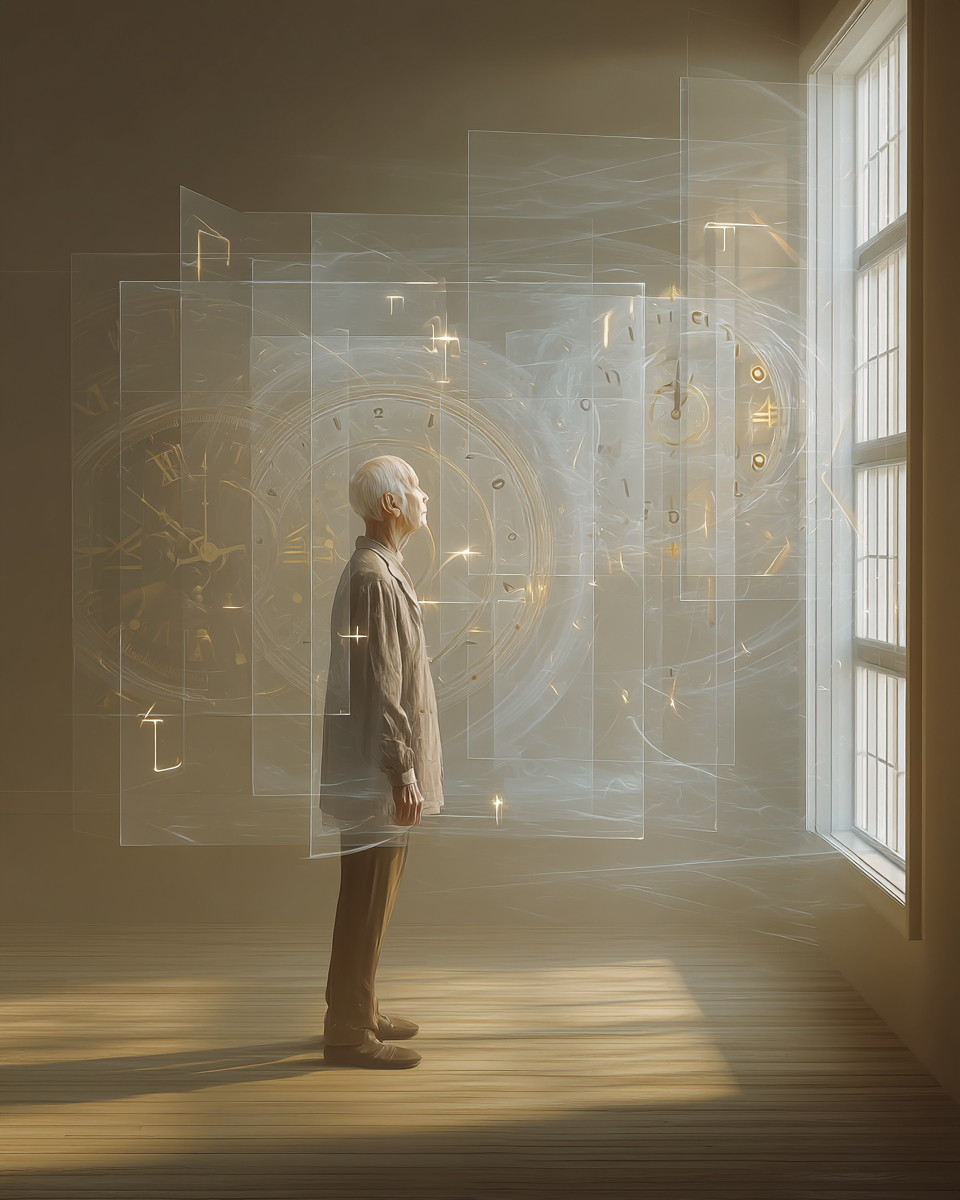
The 'Through Time' perspective is like a panorama:
You can see all the important stages of your life at a glance – past, present, and future appear like images in a gallery before you. You know where you come from, where you stand, and where you are going – the entire time unfolds as an ordered sequence before your inner eye.
Visualization
The following representation shows the typical perception of a 'Through Time' timeline – a linear sequence from the past through the present to the future, which is before the person lies and allows for a comprehensive overview.
Past -------------------> Present -------------------> Future