Design Levels / Logical Levels
Definition

The design levels are a concept originally developed by Robert Dilts within the framework of NLP.
In NLP, these levels are viewed as different "contexts" or "dimensions" that stand in a hierarchical relationship to each other. They typically include:
- Environment (Where/When): The external context in which a person finds themselves.
- Behavior (What): What a person does, their behavior or actions.
- Skills (How): The skills and abilities that a person has at their disposal.
- Beliefs/Values (Why): The beliefs and values that guide behavior and skills.
- Identity (Who): The self-image and identity of a person.
- Spirituality / Belonging (All levels): The highest context, associated with a greater meaning.
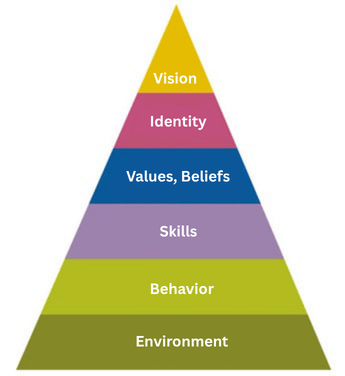
These levels form a kind of "pyramid" of human experience, with each higher level addressing deeper and more fundamental aspects of personality.
Origins and Theoretical Background
The Logical Levels were developed by Robert Dilts in the 1980s as part of his work on NLP. They are inspired by the theory of hierarchies of human thought, which is partly based on cognitive psychology and systems theory.
The idea behind the Logical Levels is that each level processes different types of information and influences each other. A problem or challenge at a higher level can affect expression and behavior at the lower levels. For example, changes in a person's identity can impact their beliefs and thus their behavior.
The model helps to understand and influence the dynamics between different aspects of life and is used in various contexts such as coaching, therapy, and personal development.
Application Examples
-
In Coaching:
A client comes to a coach with the goal of improving their professional situation and says, "I am not successful." The coach might initially ask at the skills level: "What exactly is preventing you from being more successful?" If the client indicates that they lack the necessary skills, the coach might later address the beliefs level: "What beliefs are preventing you from learning or developing your skills?" If the client has a deeper barrier regarding their identity, such as "I am just not a successful person," the coach could work with them at this deeper level.
-
In Therapy:
A client with social anxiety might ask at the behavior level: "What do you do in those moments?" and at the skills level: "What skills do you lack to handle it better?" If it turns out that deeper beliefs like "I am not worth being heard" are present, the therapist would work at this level to clarify the roots of the fear.
-
In organizational development:
A company is struggling with collaboration between departments. Here, a coach or consultant could work at the beliefs level to question which values and beliefs influence collaboration, e.g., "Why is teamwork not valued here?" If the conflict is rooted deeper in the identity of the organization, such as "We are competition and not cooperation," the company might be asked to work on its vision or identity.
Areas of Application
-
Therapy and coaching:
The model of Logical Levels helps therapists and coaches break down the complexity of human challenges into understandable and manageable parts. Problems at a higher level, such as deeply rooted beliefs or identity issues, can thus be isolated and addressed. This model promotes a holistic understanding of the client and allows work on different levels of change.
-
Conflict resolution and mediation:
Understanding the Logical Levels can be used in conflict situations to recognize at which level the conflict is truly occurring. For example, disagreements at the behavior level can often be resolved by clarifying beliefs or values.
-
Leadership development and team building:
In the business world, the Logical Levels can be used to improve collaboration and communication. When teams or leaders work on their identity or values, this can lead to deeper and more effective collaboration. Similarly, the model can help encourage employees to improve their skills to act more successfully at the behavior level.
-
Personal development:
For personal development, the model is particularly valuable. It helps set goals at different levels and understand how the various parts of the self interact with each other. Working on higher levels such as identity and spirituality can lead to deeper and more sustainable changes in the long run.
Methods and Exercises
-
Applying the hierarchy of Logical Levels:
One of the fundamental methods for working with the Logical Levels is to approach a problem or goal from the bottom up. Start with the question: "What do you do (behavior)?" and then move to the next levels to explore deeper causes: "What skills do you need for that?" "What beliefs do you support?" "How do you define yourself?" This method helps to address problems from the concrete level to the fundamental identity questions.
-
Visualizing levels:
A common exercise is the visualization of the Logical Levels. The client is asked to imagine that their problem lies at a certain level and then to shift it to a higher or lower level. For example, one might visualize a change in behavior as part of a larger, identity-related goal.
-
Reframing through levels:
A reframing approach in NLP might involve viewing a negative belief in a higher context. For example, someone with the belief "I am a failure" might be asked how this belief is viewed in relation to their identity and higher life purpose.
Synonyms or Related Terms
- Hierarchical levels
- Systemic levels
- Categories of experience
- Structural levels
Distinction
The Logical Levels are not the same as the meta-model questions, which focus on specific language patterns. While the meta-model primarily addresses linguistic distortions and imprecise formulations, the Logical Levels involve a deeper, structured analysis of the various aspects of a person or situation that can effect change.
Scientific or Practical Benefit
- Individually: Understanding and applying the design levels leads to a more comprehensive perception of one's own experience and behavior. This allows for deeper changes that affect not only superficial behaviors but also fundamental beliefs and identity questions.
- Practically: In coaching, therapy, and organizational development, this model enables a targeted and structured approach to change processes. By considering different levels, interventions can be designed more precisely and effectively.
Criticism or Limitations
- Complexity: Applying the Logical Levels can be challenging in complex cases. Especially when a person is blocked on multiple levels simultaneously, it can be difficult to identify the right level for an intervention.
- Subjectivity: As with many NLP models, the application of the Logical Levels is not always empirically validated. Critics argue that the theory is too abstract and does not always provide concrete, scientific evidence.
Literature and References
- Dilts, R. (1990). Changing Belief Systems with NLP. Meta Publications.
- Dilts, R. (1999). The Hero's Journey: A Voyage of Self-Discovery. NLP Comprehensive.
- Bandler, R., & Grinder, J. (1975). The Structure of Magic I: A Book About Language and Therapy. Science and Behavior Books.
Metaphor or Analogy
The design levels are like different parts of a house. The environment is the garden (i.e. what surrounds you), the behavior is the furniture (i.e. what you do), the Skills are the tools you use to maintain the house (i.e. how you do it), the beliefs are the structure of the house (i.e. why you do it), the Identity is the floor plan (i.e. who you are), and the spirituality is the purpose of the house (i.e. what it’s really about).