Autogenic Training
Autogenic Training is a relaxation technique originally developed by Johannes Heinrich Schultz to actively bring the body into a relaxed state.
It is now known (and also medically recognized) that Autogenic Training has other benefits as well. It is widely used today for stress relief - just like the related technique of Progressive Muscle Relaxation developed by Jacobson. Autogenic Training is practiced in interconnected exercises that lead to a relaxed state. A guide is needed to learn it, so that the exact procedure is followed.
Table of Contents
What is Autogenic Training?

Autogenic Training is a method that leads to the relaxation of the body through simple sentences. The method is based on Autosuggestion. Hypnosis and Autogenic Training have much in common, as Schultz oriented himself to hypnosis techniques during its development. By inputting formulas, the body is relaxed and even reaches deep relaxation. This state can then be used to influence the subconscious, just like in hypnosis. To achieve this, the exercises must be mastered very well.
How does Autogenic Training work?
In the autogenic exercises, formulas are mentally input such as "I am completely calm" or "My arms and legs are completely warm". This leads to a genuine feeling of calm or warmth during the exercise. The individual sentences cover the entire spectrum of physical reactions to relaxation: calmness, warmth, heaviness from muscle relaxation, as well as calm breathing and a steady heartbeat. Schultz found that the body actually relaxes when these symptoms of relaxation are triggered by inputting the autogenic formulas.
With these formulas, the autonomic nervous system is indirectly addressed, which is responsible for switching between tension and relaxation. Unlike skeletal muscles, certain bodily functions cannot be actively controlled. One can consciously decide to lift or lower a leg, thereby actively inducing muscle tension and relaxation, but the heartbeat cannot be increased or decreased in the same way. However, this is possible indirectly, and this fact is utilized here.
Autogenic Training Short Guide
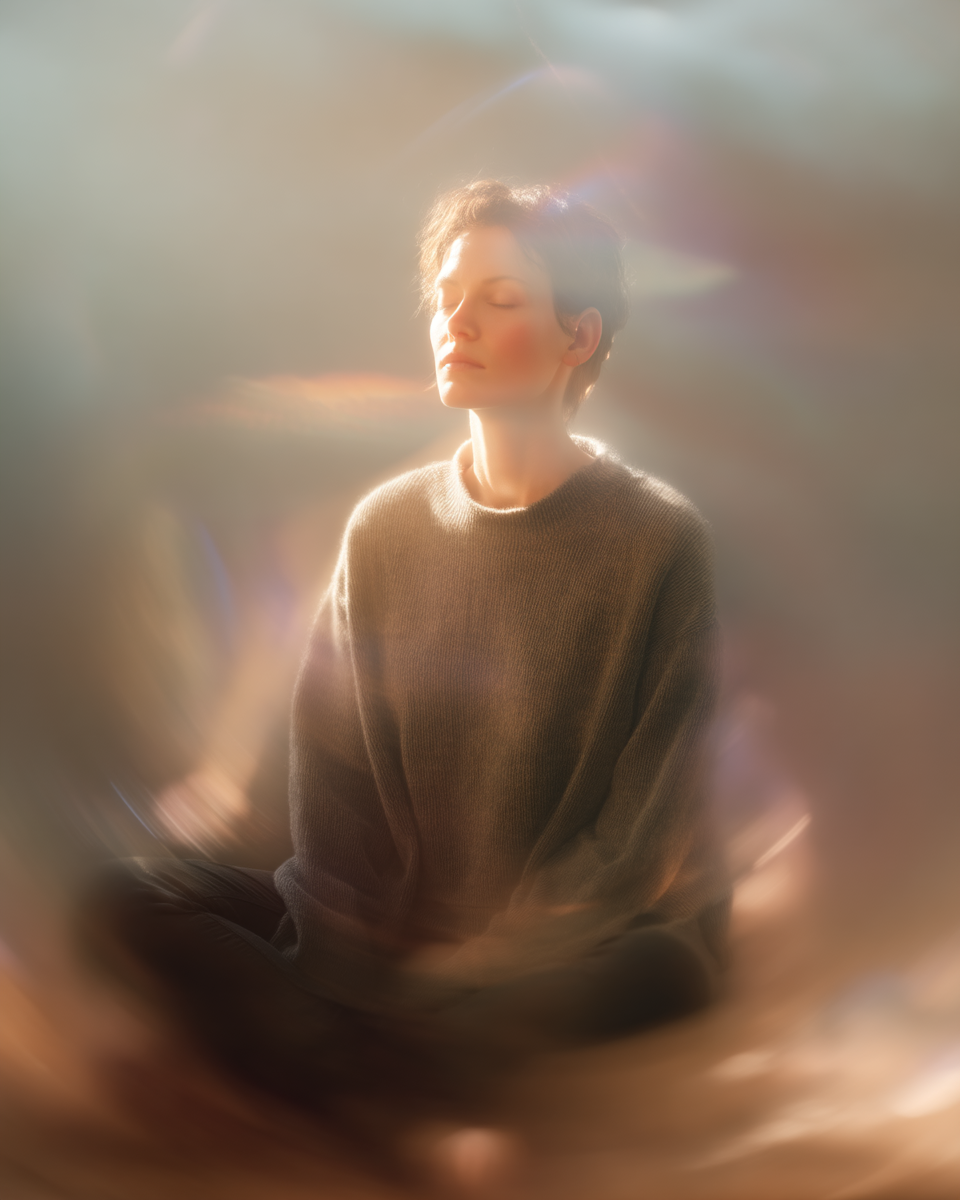
The exercise is practiced lying down or sitting in a relaxed position. The eyes are closed. Mentally, the following sentences are gone through. The sentence "I am completely calm" includes the other formulas. The remaining sentences are repeated mentally six times each. At the end of an exercise session, there is the so-called withdrawal: To return to a wakeful and receptive state, one stretches and shakes the limbs.
"I am completely calm."
"My arms and legs are completely warm." (6 repetitions)
"I am completely calm."
"My arms and legs are completely heavy." (6 repetitions)
"I am completely calm."
"My heart beats calmly and evenly." (6 repetitions)
"I am completely calm."
"My breathing is calm and even." (6 repetitions)
"I am completely calm.
"My belly is pleasantly warm." (6 repetitions)
"I am completely calm.
"My thoughts are fresh and clear." (6 repetitions)
"I am completely calm."
In a course, normally one new exercise is learned each week, so that one gradually gets used to the entire process.
It is important that the exercises are repeated at home, preferably three times a day.
Meanwhile, two different short variants have also become established. As Autogenic Training becomes more complex with an increasing number of exercises, shorter variants help to integrate the practice more easily into daily life. However, to apply the short variants, the user should already have some practice. There is the option to practice with just individual words (for example, "Heaviness" or "Breath") or to reduce the number of repetitions to 3.
Autogenic Training Exercises
Warmth Exercise
Starting Point: Find a quiet, undisturbed place for yourself alone. It doesn't matter in which position, whether you want to perform Autogenic Training sitting or lying down. You can sit or lie on a comfortable sofa, chair, or armchair. Place your arms beside your body or on the armrests. It is also important that your legs do not touch.

- Close your eyes and take 3 to 4 deep breaths in and out. Feel where your body touches the surface it is lying or sitting on, for example, your back against the chair or armchair back, or your feet or just the soles of your feet against the ground. Enjoy how your muscles begin to relax and how you become calmer and calmer. The entire process takes place at your own pace. Now focus on the "Calm Formula":
"I am completely calm, calm and relaxed".
However, you do not say this out loud to yourself, but with your inner voice. Repeat the Calm Formula 4 to 6 times. If you already have experience and practice in Autogenic Training, it will be easier for you to reach this state of calm. Adjust the number of repetitions of the Calm Formula according to your progress. - Then, direct your concentration to your dominant arm, the arm with which you write. Start by feeling your upper arm down to your elbow. Then your forearm down to your hand. Finally, feel in your hand and in each of your fingers.
Now that you can feel your arm, focus on the Warmth Formula. Again, with your inner voice, say to yourself:
"My right / left arm is pleasantly warm".
Repeat this process 4 to 6 times as well. Here too, with regular practice, you will feel the pleasant warmth in your arm more quickly and intensely.
Take your time here as well. Autogenic Training is not a competition where you have to come in first. - Now shift your focus from one arm to the other arm. Here too, say to yourself with your inner voice:
"My right / left arm is pleasantly warm".
Repeat this process 4 to 6 times as well. - Now focus again on both arms. Here the formula is:
“My two arms are pleasantly warm”.
Repeat this process 4 to 6 times as well. Stay a little longer in this pleasant, relaxed state and continue to relax with each breath. Try to intensify the warm feeling and expand it to your entire body. - To conclude, return once more to the relaxation formula:
"I am completely calm, calm and relaxed".
Repeat this process 4 to 6 times. - It is important to activate yourself again after the autogenic training to avoid drowsiness and dizziness. Stretch and extend yourself completely, take a deep breath once more, and open your eyes again. If you are using the training to fall asleep, this point naturally does not apply to you.
Autogenic Training Guide with Steps

The Basic Level
The starting point in autogenic training is called the basic level, which forms the foundation upon which all later stages build. Here, you practice physically relaxing and working with the help of self-suggestion. The learned applications are the basic prerequisites for further and more in-depth courses. There are 6 different basic exercises, which are performed in your preferred position. The exercise begins with the so-called "relaxation formula," which goes as follows: "I am completely calm, relaxed, and at ease. My thoughts come and go.“ After the introduction through the "relaxation formula," you begin to enter one of the 6 stages.
1st Stage: The Heaviness Exercise
In the "heaviness exercise," as the name suggests, physical relaxation is achieved by creating a pleasant feeling of heaviness. You start with the dominant arm, meaning the right one for right-handed people and the left one for left-handed people.
The suggestion is: “My right / left arm is pleasantly heavy”.
The focus is on the chosen arm. It can be observed that the arm feels heavier and heavier with each repetition of the "heaviness formula."
The feeling of heaviness is created by the relaxing muscles of the arm. The "heaviness formula" should be repeated 4 to 6 times as needed. Once a pleasant heaviness is felt in the chosen arm, the relaxation formula is repeated, and you move on to the next desired body part, for example, the other arm or one of the legs. Here, you again apply the "heaviness formula" following the previously described process.
The last step of the "heaviness formula" encompasses the whole body:
“My whole body is pleasantly heavy”.
It is important to return the body to its normal state after performing the exercise. This conclusion of the exercise is intended to avoid fatigue and dizziness. The conclusion usually consists of three stages. First, the limbs are loosened by stretching and yawning. Additionally, you take a deep breath in and out. Finally, the eyes are opened. If the "heaviness exercise" is used to assist with falling asleep, a conclusion is not necessary.
2nd Stage: The Warmth Exercise
The process of the "warmth exercise" is identical to that of the heaviness exercise. Here, only the suggestion changes. Instead of "My right / left arm is pleasantly heavy," it is used here.
"My right / left arm is pleasantly warm" It is also advisable to repeat the exercise 4 to 6 times until a pleasant feeling of warmth is created. This process continues until the suggestion is:
“My whole body is pleasantly warm”
It is also important, if the exercise is not used during falling asleep, to properly conclude the suggestion and return the body to its normal waking state..
Further down, there is a
more detailed instruction on this. 3rd Stage: The Heart Exercise
In the heart exercise, it is important to feel your own heart rhythm and consciously perceive the heartbeat. The suggestions at this stage can be:
“My heart beats calmly and evenly”
“I feel pleasantly warm around my heart” or If this exercise causes discomfort or even leads to anxiety, it should be skipped, and you can simply move on to the next stage. Optionally, the suggestion "heartbeat" can be replaced with the suggestion "pulse.".
4th Stage: The Breathing Exercise
In the breathing exercise, the focus is on observing your own breathing rhythm. Here, the breathing should only be perceived and not influenced. The concentration is on the depth of the breaths, how evenly and regularly you inhale and exhale. Suggestions can be:
“I breathe calmly and evenly”
“Every breath relaxes me further” or 5th Stage: The Solar Plexus Exercise.
The solar plexus exercise is not a completely new exercise, as it also aims to create a pleasant feeling of warmth. The difference from the warmth exercise described above is that here the warmth is directed to a specific place in the body, namely the abdominal area. With the help of this exercise, blood circulation in the abdominal area is increased, which stimulates metabolism and promotes digestion. Formulas for the "solar plexus exercise" are:
“The belly flows warm”
, or“The center is flowing warm” It can be helpful for the suggestion to imagine how sun rays shine on the belly, creating a pleasant feeling of warmth..
6th Stage: The Forehead or Head Exercise
In this stage, unlike the previous stages, the goal is not to create a pleasant warming feeling but a pleasant cooling feeling on the forehead. To support the suggestion, you can imagine a light, cooling, and pleasant breeze on the forehead. This exercise is especially helpful for people who work a lot with their heads or suffer from headaches. The feeling of cooling on the forehead is always external on the forehead, not inside the head. If autogenic training is used as a sleep aid, this exercise should be skipped, as it refreshes and reactivates rather than calms and relaxes. Formula formulations are:
“My head feels pleasantly cool and light,” “My head is free and clear,” “It is pleasantly cool on my forehead,” “My head is relaxed and loose,” “The pressure in my head has vanished”
The Intermediate Level.
The intermediate level deals with forming positive intentions that arise individually. These
goals can target health conditions or a self-imposed life goal. Formulated sentences are created that are positively phrased and concise. The formula sentence should not be "away from," e.g., "I want to be less insecure," but rather "towards," e.g., "I am confident." The formulas are reinforced by accompanying images and fantasy journeys. Thoughts make people, following the motto: “ können auf den Gesundheitszustand oder auf ein selbst gestecktes Lebensziel abzielen. Es werden formelhafte, positiv formulierte, prägnante Sätze gebildet. Der Formel-Satz sollte nicht „Weg-von“, z.B. "Ich will weniger unsicher sein", sondern „Hin-zu“, z.B. "Ich bin selbstbewusst", formuliert sein. Verstärkt werden die Formeln durch begleitende Bilder und Fantasiereisen. Die Gedanken machen Menschen aus, ganz nach dem Motto: „You are what you think.However, it is not enough to just think the desired thought; it must also be believed. In the intermediate level, it is advisable to work with an experienced therapist to develop suitable formulas together. To work at the intermediate level, the basic level should be mastered securely. The application area of the intermediate level includes desired changes in attitude, behavior, and physical aspects. Possible goals for behavior change using formulaic intention formation are, for example, addressing sleep disturbances: "I sleep deeply and soundly.", "Calm and secure, I sleep until morning."
1. Step:
In the first step, the trainee repeats the exercises of the basic level. (Duration 3-5 minutes)
2. Step:
Personal suggestions for achieving the goal are repeated at short intervals. (Duration 3-5 minutes)
3. Step:
There is a break.
4. Step:
The personal suggestions from step 2 are internalized again. (Duration 3-5 minutes)
The advanced level
The advanced level includes additional meditative and imaginative concepts. It is divided into seven successive phases with different guiding principles. With the help of the previous relaxation exercises, the trainee is in a state that gradually allows them to immerse themselves in images and situations and experience them in the here and now. The goal of the advanced level is self-awareness and personality development. Characteristic of the advanced level is the great individual creative freedom of the exercises.
In the advanced level, the experience of individual color experiences and the visualization of specific objects is trained more intensively. By bringing to mind colors, images, objects, abstract concepts, people, and fantasy journeys, the depth of the unconscious is explored. This includes disturbing thoughts, images, feelings, situations, and experiences that burden the person and hinder their liveliness and maturation. The effectiveness of the exercises in the advanced level is also referred to as an internally "cleansing" process. Furthermore, in the advanced level, deep introspection of ideal values and concepts, such as honesty and happiness, as well as questions about one's own personality development and life goals, play an important role: Who am I? How could I be? What should I do?
1. Phase: Color experiences
The trainee generates an inner color through autosuggestion. They enter a relaxed state, let their eyeballs glide upwards behind closed eyelids, and say: "A color is developing before my inner eye." This formula is repeated six times. Then the trainee says: "It is my color."
Sometimes it takes several weeks for a color to appear to the trainee through continuous practice. The color seeing should be a process of four minutes. The spoken sentences "The color is retreating." composure "The color has disappeared. Breathe deeply, take a deep breath, open your eyes!" conclude the first phase.
2. Phase: Perceiving concrete objects
This phase already counts as advanced meditation. Here, for example, the trainee practices making a blooming tree appear before their inner eye: "A blooming tree is developing before my inner eye. The image becomes clearer. The blooming tree stands clearly before me." The perception of the tree should last about four minutes.
The trainee concludes the exercise by saying the sentences "The image is retreating. It has disappeared. Breathe deeply, take a deep breath, open your eyes!" 3. Phase: Contemplation of ideal values
In this phase, the trainee evokes concrete images for ideal values such as hope, love, honesty, harmony, and happiness.
“An image is developing before my eye: I see and experience honesty.”
Negative images usually indicate unresolved themes. The phase ends with the words
"The image is retreating. It has disappeared. Breathe deeply, take a deep breath, open your eyes!" 4. Phase: Character formation
In this exercise, one should focus on the goal of self-awareness.
"A mirror is developing before my inner eye. I see myself in this mirror as I truly am."
With the help of the formula, desired changes can be implemented, such as a change in diet. Through autosuggestion, one can adjust the reflection to their target image. Thus, the ideal figure can be brought into focus.
"Hearty food is indifferent to me."
The trainee concludes the exercise with the following sentences:
"The image is retreating. It is disappearing. Breathe deeply, take a deep breath, open your eyes!" 5. Phase: Path on the seabed
The trainee should practice developing a clear image. They walk for a few minutes on the seabed.
"An image is developing before my inner eye. I see myself on the shore of the sea. I walk calmly and serenely, step by step, deeper and deeper down towards the seabed."
After the exercise, the trainee says:
“I am gradually detaching from my image and returning to the shore of the sea. Breathe deeply, take a deep breath, open your eyes!”6. Phase: Path to the mountain peak
"An image is developing before my inner eye. I see a high mountain before me. I climb calmly and serenely, step by step, higher and higher up the mountain."
During the ascent, feelings of euphoria may arise. When the trainee feels light, free, and secure, they can spread their wings like a bird in their imagination and take a flight. Afterwards, they spend some time on the mountain peak.
Während des Aufstiegs kann es zu Euphoriegefühlen kommen. Wenn sich der Trainierende leicht, frei und sicher fühlt, kann er in seiner Phantasie wie ein Vogel die Flügel ausbreiten und einen Rundflug anschließen. Im Anschluss verteilt er einige Zeit auf dem Berggipfel.
"I am gradually letting go of my image and returning to the foot of the mountain. Breathe steadily, take a deep breath, eyes open!"
7. Phase: Individual images with personal goals
In the seventh exercise step, the trainee can create their own ideas and images.
When distressing images arise, they can be resolved using the following formula:
"I am gradually letting go of my image and slowly returning to the foot of the mountain. Arms steady, take a deep breath, eyes open!"
Applications of Autogenic Training
Autogenic Training against Stress
Autogenic Training is most commonly used for stress reduction. The exercises lead to relaxation during training and also improve the ability to withstand stress and relax in the long term. Often, Autogenic Training is only learned when there is already a permanent disturbance in the autonomic nervous system, meaning one is almost constantly under tension. Autogenic Training interrupts this vicious cycle, so that regular practice leads to being more relaxed and less susceptible to stress in everyday life.
In coaching, Autogenic Training can be used for stress reduction, especially at the beginning of a coaching session, to find a more relaxed attitude from which problems can be viewed with a bit more distance and less emotion. This helps in making more rational decisions and better reflecting on one's situation.
Autogenic Training against Anxiety
Anxieties can also be successfully reduced. This is achieved partly by learning the right techniques that help one become calmer and more composed. Additionally, the formulaic intention formation of the intermediate level can be actively used to address anxieties. Thus, Autogenic Training is very helpful on a journey, as it can reduce fear of flying and travel sickness. Furthermore, the training helps against claustrophobia and can also be used to reduce nervousness before a public appearance.
Autogenic Training for More Inner Calm
Regular practice leads to a quicker return to a relaxed state after a tension situation has been mastered. In everyday life, more inner balance is achieved, as one no longer gets caught up in stressful situations. Therefore, regular application of Autogenic Training leads to more composure and an improved quality of life.
Autogenic Training for Falling Asleep
Autogenic Training for falling asleep is also very common. A common first symptom of stress is often problems with sleeping. Here too, Autogenic Training can help. Many users report that they almost immediately fall asleep while practicing lying down. The state of relaxation achieved through the exercise allows for (finally) carefree falling asleep again. The restorative sleep is often deeper and less disturbed. Many users swear by Autogenic Training for falling asleep, even if they otherwise apply the technique less frequently.
Autogenic Training for Children
Children often do not yet have sufficient reflective abilities to learn the techniques as intended. Learning is only meaningful from about the age of 14. Nevertheless, elements and exercises can be used in groups with younger children to provide them with a more relaxed experience. More and more children suffer from hyperactivity and sensory overload and hardly know any ways to reduce stress. In this respect, Autogenic Training can be a help for children and stressed parents to better manage their everyday lives.
High Blood Pressure and Autogenic Training
High blood pressure is often due to the heart having to exert too much force to pump blood through the veins. One of the formulas specifically aims to dilate the vessels, allowing blood to flow more easily. This is an important component, as it is one of the relaxation symptoms that should be induced. As a "side effect," regular practice simultaneously leads to a reduction in blood pressure and effectively supports therapies that are also used to treat high blood pressure. This positive effect on the body is scientifically proven by independent medical studies.
Epilepsy and Autogenic Training
Autogenic Training is widely used in various therapies, including for epilepsy. Although Autogenic Training cannot cure epilepsy or make medication unnecessary, learning this technique helps to alleviate the symptoms of epilepsy and manage the condition better.
Autogenic Training against Nausea
Since a state of complete relaxation is achieved through the exercise, physically induced complaints such as nausea can also disappear through the training. This occurs especially when nausea is caused by nervousness or stress. The special aspect here is that it is not the physical discomfort itself that is fought against, but the underlying psychological causes, so that nausea does not even occur.
Autogenic Training to Strengthen the Mind
Regular practice not only helps to become calmer and more stress-resistant, but also leads to developing a healthier relationship with one's emotions. One no longer succumbs to sudden moods, does not easily fall into anger or sadness. One can also learn to let go through Autogenic Training and exclude negative influences and racing thoughts from one's life. This happens partly through the positive effects that regular training brings. On the other hand, such points can also be actively addressed in the intermediate level through formulaic intention formation. For this reason, Autogenic Training is also used as a supportive tool in psychotherapy, for example in the treatment of depression.

History of Autogenic Training
Relaxation techniques have existed since ancient times. The "original form" of Autogenic Training was practiced by Buddhist and Indian monks. However, these "original forms" are heavily dependent on the environment of the practitioner, meaning they are hardly applicable without the local worldviews. The Autogenic Training as it is known today was established in the 1920s by the Berlin physician and psychotherapist Johannes Heinrich Schultz. The goal was to invent a relaxation method that is easy for everyone to learn. Another advantage of Autogenic Training over the "original forms" is that this method works completely independent of the cultural environment.
Schultz was strongly influenced by the hypnosis that was emerging at the time, creating a close connection between the two. Schultz used hypnosis to develop his techniques by hypnotizing students and then asking them what they felt during the transition from the waking state to the so-called trance state. Many subjects reported a feeling of heaviness in the dominant arm, the writing hand. Building on these insights, Schultz developed a self-help method based on scientific principles and published the first work on "Autogenic Organ Exercises" in 1926. His first book was published in 1932 under the title "Autogenic Training – Concentrative Self-Relaxation."
Where can Autogenic Training be learned?
One can learn Autogenic Training by obtaining an audio or video course or attending a live seminar. Typically, Autogenic Training is learned under guidance. In a course lasting six to eight weeks, the basic level of Autogenic Training is taught, which consists of the six basic exercises (such as the warmth exercise and the breathing exercise). Afterwards, one should be able to perform the Autogenic Training exercises independently - that is, in an autogenic way. Many courses also combine the exercises with other relaxation techniques, such as elements from yoga, meditation, or progressive muscle relaxation. Meditations on mindfulness and Autogenic Training are also widespread, as both techniques contain very similar elements. Guided imagery journeys are often used in Autogenic Training courses as well. A guided imagery journey is a guided meditation where one imagines traveling to a particularly beautiful place.
The autogenic exercises of the basic level are completely sufficient to master Autogenic Training and achieve the positive effects on relaxation and restorative sleep. Those who want to learn more Autogenic Training have the option to work at the intermediate level with formulaic intentions - for example, using Autogenic Training to quit smoking or reduce weight - or at the advanced level with the concept of so-called autogenic imagination. In this respect, a guided imagery journey is even a first step towards the advanced levels of Autogenic Training. The advanced levels of Autogenic Training aim to utilize the achieved state of relaxation to work on personality. Therefore, these levels are particularly well-suited as building blocks of a coaching program.
Some courses also offer the practice of Autogenic Training with music, which contradicts the fundamental idea of the training. Autogenic Training has its origins in hypnosis, so the text is the focus in Autogenic Training.
Autogenic Training is usually taught by a psychologist or a relaxation trainer. Some fitness studios also offer courses. The training to become a relaxation trainer is not legally protected, so anyone can offer it. However, a quality feature is the recognition by health insurance companies, which carefully examine the professional and personal qualifications of the trainer and the structure of their course before subsidizing courses.
Alternative to Autogenic Training
Of course, there are other techniques for stress reduction that can also be used complementarily in coaching and produce similar effects as Autogenic Training.
The most well-known of the alternative relaxation techniques is Progressive Muscle Relaxation according to Jacobson. The goal of Progressive Muscle Relaxation is, just like in Autogenic Training, relaxation. To achieve this, individual muscle groups are first tensed and then released. This leads to particularly effective muscle relaxation, which also results in relaxation of the mind. Progressive Muscle Relaxation according to Jacobson can also be used for stress reduction and focusing. A combination of Progressive Muscle Relaxation with the intermediate or advanced levels of Autogenic Training is also conceivable.